
I’ve talked about this a lot when it comes to clothing, but it’s just as relevant for other fabrics in the home: the textile industry is still largely unregulated.
When you flip over a fabric tag, you’ll typically only see the fiber content (cotton, linen, polyester, etc).
What you won’t see? The long list of processing chemicals that may or may not have been used along the way. From adding “performance” features like stain resistance, to applying anti-mildew treatments before products are shipped overseas, there are countless chemicals that can be involved.
Not all of these additives are harmful, of course, but many can be. The list includes PFAS, phthalates, formaldehyde, heavy metals, azo-based dyes, and more.
And just like with clothing and bedding, everyday household linens aren’t exempt. Tablecloths, runners, cloth napkins, placemats, and other table linens can vary widely when it comes to safety and environmental impact. That’s a big reason why more people are gravitating toward things like organic cotton napkins and truly eco-friendly tablecloths for their dining spaces.
My goal here is to cut through the noise and save you time. Below, you’ll find vetted brands offering non-toxic tablecloths that align with both your aesthetic and your values, whether you’re setting the table for everyday meals or special gatherings.
Here's what this guide includes:
- Here’s Where to Get Non-Toxic Tablecloths:
- Magic Linen
- Coyuchi
- Lorena Canals
- Anchal Project
- Pottery Barn / Williams Sonoma
- Splash Fabric (non-toxic wipeable tablecloths)
- Here’s What To Look For In a Non-Toxic Tablecloth:
- Skip the PVC and choose organic cotton or linen instead.
- Avoid “performance” features…
- …Or at least look for safer coatings
- Consider patterns instead of solid colors
- Does washing your table linens before use get rid of the chemicals?
- 🍋 Join Thousands of Subscribers Reducing Toxic Chemicals
This guide contains product recommendations and we may receive compensation if you purchase through certain links. As always, we only make recommendations that are genuine!
Here’s Where to Get Non-Toxic Tablecloths:
I’ll get right to the brands first. If you want to read more about what exactly to look for in safer and more sustainable table linens, scroll down.
Magic Linen

Carries: Tablecloths, table runners, placemats, napkins, aprons, tea towels, oven mitts, pot holders, bread bags
Price Range: $12 (linen tea towel, on sale) – $200 (tablecloth)
Machine-Washable? Yes
One of the reasons I personally love Magic Linen is the size of their collection… You can basically get everything you need for your dining room table in one place. (I also have a bath robe from them and I love it.)
I love the colors and patterns they offer, from neutral and bold solid colors, to gingham, striped, botanical print, and even pom-pom lined—ugh, so cute!
As their name indicates, most of these kitchen linens are made from linen. They use 100% European flax, which is stone washed for maximum softness (btw, linen actually gets softer as you use and wash it!). Plus, they’re OEKO-TEX certified, which means they’ve been verified to be free from a list of toxic chemicals.
Magic Linen also has various other sustainability initiatives as well, including a zero waste collection, for which they find ways to make even more beautiful, practical goods out of fabric waste.
Coyuchi
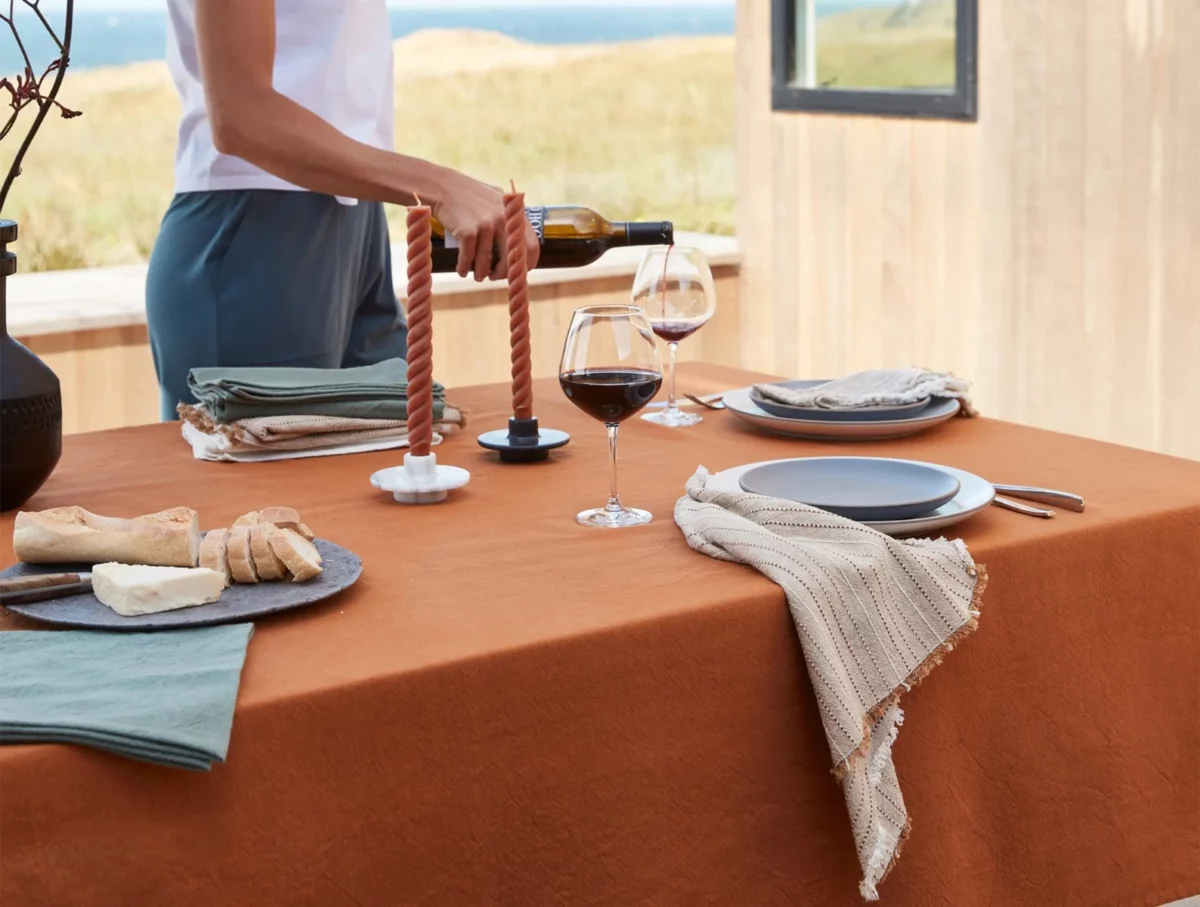
Carries: Tablecloths, kitchen towels, table napkins, aprons, bowl covers
Price Range: $20 (set of 4 napkins) – $168 (tablecloth)
Machine-Washable? Yes
Coyuchi is one of my favorite brands for organic bedding, bath towels, and other home textiles. Part of the reason I love this brand so much is that their pieces are always high-quality, and the designs are relatively timeless… so they can still look good in your home years later.
Coyuchi carries most of the practical fabric goods you need for the kitchen—from tablecloths and napkins, to cooking aprons and bowl covers for storing leftovers.
Everything is made out of 100% GOTS certified organic cotton, which is grown and woven ethically in India. Most of their products are also OEKO-TEX certified and are made in a factory that recycles 98% of its wastewater.
Lorena Canals
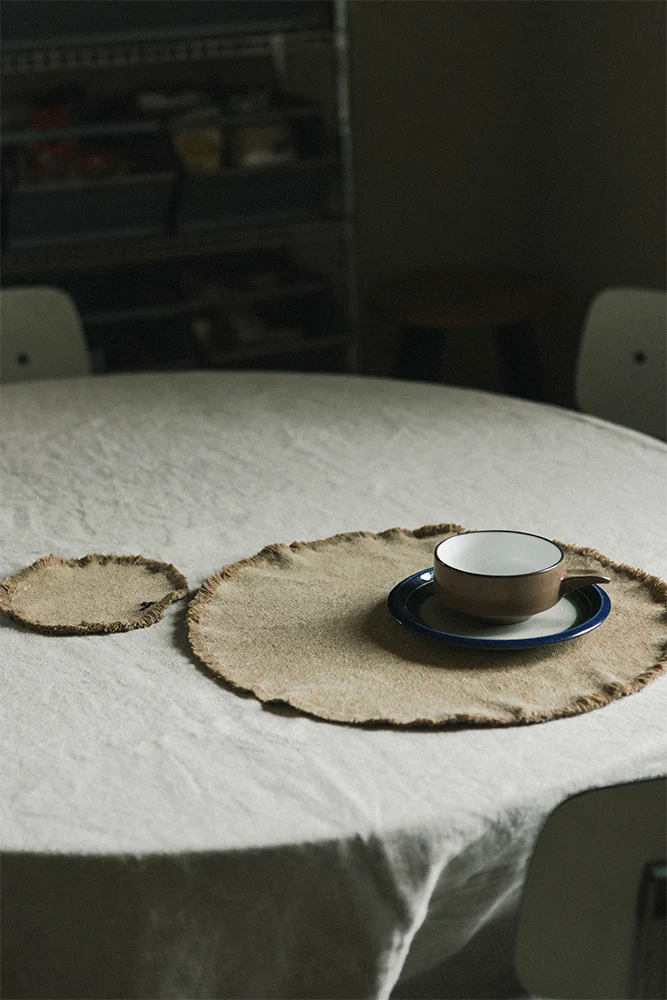
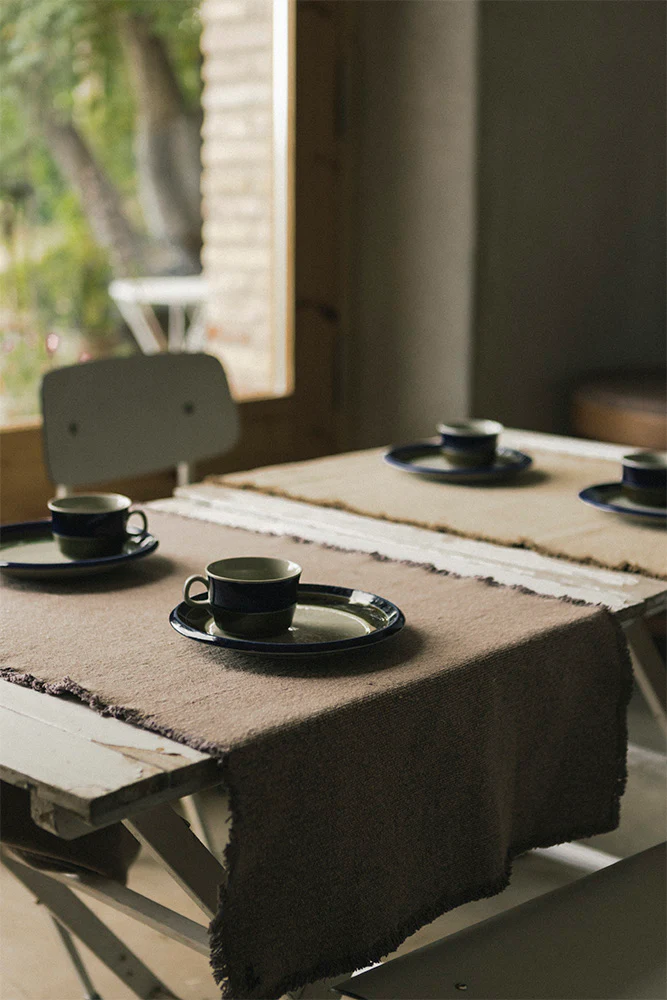
Carries: Table runners, placemats, coasters
Price Range: $45 – $89 (set of 4)
Machine Washable? Yes
Lorena Canals is one of my favorite brands for all-natural washable rugs, but they also have a beautiful collection of sustainable table linens.
They are handcrafted by the skilled artisans they have partnerships with using natural cotton and non-toxic dyes. They have a frayed-edge look that’s both unique yet still timeless.
Anchal Project

Carries: Tablecloths, placemants, table runners, oven mitts, pot holders, coasters, aprons, tea towels
Price Range: $9 (tea towel, on sale) – $110 (tablecloth)
Machine-Washable? Yes
Personally, I really love Anchal’s aesthetic. It’s not really a look you’ll find anywhere else, with their block prints, thick stiches, and bold, contrasting colors.
Pretty much all of their products are made out of 100% GOTS certified organic cotton, although some of them use upcycled vintage cotton saris instead(!).
Not only that, but they’re all Fair Trade, too, made by artisans in Ajmer, India. In fact, Anchal is actually a non-profit, with the goal of not only creating beautiful, high-quality textiles for your home, but also partnering with women around the world to create a more ethical global trade. For a truly unique touch, each product features a hand-stitched signature of the maker.
Pottery Barn / Williams Sonoma

Carries: Tablecloths, table runners, placemats, napkins, aprons, towels, and more
Price Range: $10+ (set of organic napkins); $70-$180 (tablecloths)
Machine-Washable? Yes
If you want to be able to look at your table linens in person before you buy them, then Pottery Barn and Williams Sonoma have some good options. Many of their options are more affordable than the other brands on this list.
These are good stores to look for holiday-themed linens too, as they have designs with fall vibes, Christmas colors, and more.
Although not all of their table linens are made with natural materials, they do have plenty of options that utlize GOTS certified organic cotton (as well as conventional), natural linen, and rattan. Many of their textiles are OEKO-TEX certified as well.
At Pottery Barn, you can also use the filter features on the side bar to search for products that are “organic,” “Fair Trade,” “sustainably sourced,” and more.
Splash Fabric (non-toxic wipeable tablecloths)


Carries: Tablecloths, aprons, baby bibs, fabric
Price Range: Tablecloths start at $65+
Machine-Washable? Yes
If you’re looking for a non-toxic wipeable tablecloth for your dining table, Splash Fabrics is one of the few places you can find one.
These tablecloths are made out of 100% cotton and then laminated with a water-based urethane, which is what makes them wipeable and durable against stains. (They’re also OEKO-TEX certified and are tested for food safety in accordance with FDA standards.)
So, they’re not totally plastic-free, but it’s the best option I can find if you really want a wipeable one.
They have an awesome selection, too. They have squares, rectangles, and circles that come in standard sizes, but you can also order a custom size! Or, if you’d rather make your own, you can order just the fabric. They have lots of sewing resources available to help you out. (They have fabric swatches available, too.)
Plus, they have a ton of colors and designs available as well. All of their products are made in Seattle, Washington, USA.
These tablecloths act like “real” fabric, not the plastic-y stuff. So even though they’re wipeable, they still drape over your table well and have a high-quality look and feel to them.
Here’s What To Look For In a Non-Toxic Tablecloth:
If you’re doing your own shopping elsewhere, here are some things you might want to keep in mind:
Skip the PVC and choose organic cotton or linen instead.
A lot the of tablecloths on the market are made with PVC, which is one of the most toxic kinds of plastic. This is especially true of the single-use, disposable tablecloths, but even many of the reusable table linens contain a layer of PVC on either side of the fabric (or both), usually to make it wipeable and more resistant to water and stains.
All of this is going to add up to more microplastics in your home and in the general environment.
Instead, you’ll ideally want to go for plastic-free table linens that are made out of natural materials like cotton or linen, and colored using non-toxic dyes.
Hemp is another good option, although it’s not used nearly as often.
If you need something more affordable, conventional cotton is also a pretty good choice. Yes, it’s often grown and harvested using toxic synthetic pesticides, which is not ideal. But it’s still a natural, plastic-free fiber that could be biodegradable at the end of its life.
(I say could be because it depends on what is added to it in terms of dyes and finishes. But that’s the case for all materials!)
Avoid “performance” features…
Whenever you see some sort of “performance” feature on a textile, such as “stain-resistant” or “wrinkle-resistant,” a red flag should go up.
These features often indicate that a fabric has been treated with something. And many times, that something is a toxic chemical. For example, PFAS are used to make fabrics stain- and water-repellent. Carcinogenic formaldehyde is used to make things wrinkle-resistant. You get the idea.
There are currently no laws on the books that require companies to disclose whether or not these chemicals are being added to their textile products, and which ones. So, unfortunately, there is virtually no way of knowing for sure whether or not they’re being used (unless they explicitly say so, voluntarily). That’s why consumers are forced to look for “hints” such as these performance claims.
Although it’s certainly not guaranteed that an organic table runner or tablecloth is free from these toxic chemical treatments, it’s certainly more likely that your table linens are going to be safe and non-toxic if you buy them from a brand that prioritizes things like organic materials and eco-conscious manufacturing processes.
…Or at least look for safer coatings
You might be thinking: “But Abbie! I need my table linens to be wipeable, water-resistant, and stain-repellent! I have kids! We are messy!”
I hear you.
First, let me point out that most of the table linens I’ve recommended above are machine-washable. (Most are meant to be washed and dried on gentle.)
But if you definitely want a non-toxic wipeable tablecloth, there are safer options out there that are PVC-free and PFAS-free.
The main thing you’ll want to look for is a PU or TPU coating over a natural fabric such as organic cotton. PU and TPU are still types of plastic, which are not entirely natural or non-toxic. But they are both definitely better than PVC and PFAS. As far as I know, they are currently the safest options available for making something waterproof and wipeable. (I talked about this more in-depth in my guide to waterproof mattress protectors.)
A couple of brands that carry non-toxic wipeable tablecloths (and other linens) using TPU/PU include Splash Fabric (mentioned above) and PlaceMatFab.
Consider patterns instead of solid colors
Another little tip I have for you when it comes to stains is to choose a patterned design instead of a solid color. That way, any food spills that do happen will be more easily hidden inside the shapes and colors. If you take this approach, you won’t have to worry so much about getting a tablecloth that has a stain-resistant treatment added to it.
P.S. On a related note, you might find this guide helpful when it comes to removing stains!
Does washing your table linens before use get rid of the chemicals?
Can any of these chemicals that may or may not be added to table linens be washed out?
It depends.
As you can imagine, some of the chemicals are meant to stay attached to the fabric, even through washing.
(The problem, of course, is that we know that doesn’t happen… Even though you can’t wash PFAS out of products, for example, these toxicants don’t stay in products either. Rather, they slowly leach out over time, especially as the textiles age and start to break down.)
That said, I personally still wash all of my clothing, bedding, and other textiles before I wear or use them. That’s because if there are any excesses in chemicals present (such as dyes), or if there were any extra chemicals that were added at the end (such as antifungals meant for preservation during shipping), then some of those will likely wash out.
I hope you have found this guide to organic and non-toxic table linens helpful! If you want to stay updated on new content (and get a bunch of other tips, tricks, and more delivered to your inbox once a week, subscribe to Filtered Fridays.

Would really like a source for something with colors. Does liking lavender, lighter blue, and such colors require dyes that are toxic?
Hey Dale, many of the brands included here do have those lighter colors you mentioned – light blue, etc. Usually it’s the really BRIGHT colors (red, orange, etc) that are more likely to be toxic. (Doesn’t necessarily mean they are, just that it’s more likely.)