Subscribe to our weekly email newsletter. →

First, a note from the editor:
I’ve addressed a lot of these questions before, but when I read a recent newsletter from Rachel from BYOB about her experience discovering that “food-safe” silicone was not always the best, I asked if she’d write us an article about her own perspective actually SOURCING high-quality silicone for her brand.
This guest article is written by her! In it, we address a lot of common questions about silicone, including:
- what’s the difference between LFGB and “food safe” silicone?
- is silicone the same as plastic?
- what should you look for in a high-quality silicone product?
Baking mats. Spatulas. Baby teethers. Food-storage containers.
We use silicone for a LOT of things that touch our food and, in some cases, literally go into our babies’ mouths.
But until I started researching silicone for myself, I had no idea how much one silicone product could differ from another.
And I definitely didn’t expect to spend years learning about it.
My silicone rabbit hole started with a bad lunch container.
Years ago, I bought my son a blue collapsible silicone lunch container.
It was thin. It collapsed. It leaked. It smelled. Eventually, it ripped.
Four months later, it ended up in a landfill.
A few years later, I was becoming much more intentional about sustainability and the materials touching my family’s food. One thing that really bothered me was bringing home restaurant leftovers in another disposable container every time we ate out.
Some were flimsy and messy, and I also didn’t love the idea of hot food sitting in plastic or other materials I knew very little about.
I thought: why can’t I just bring my own reusable container?
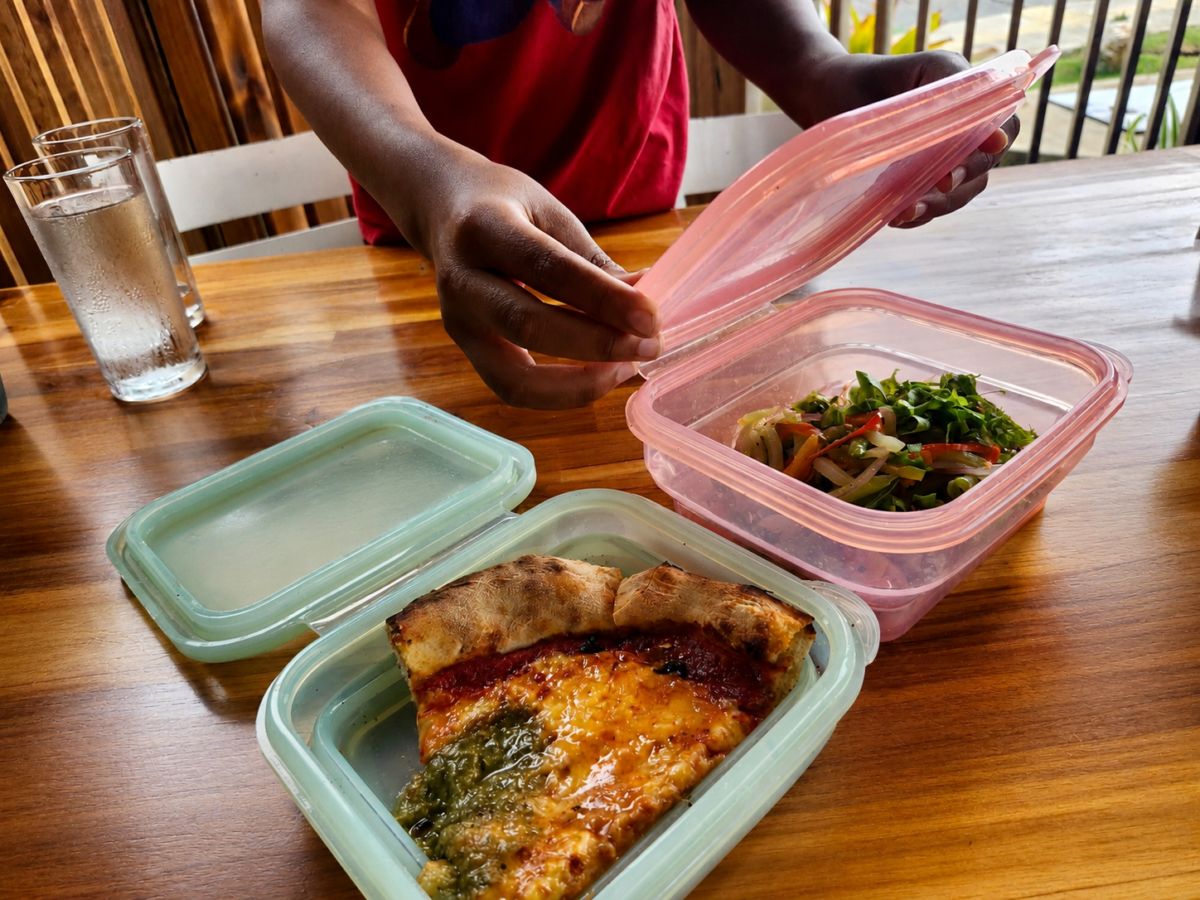
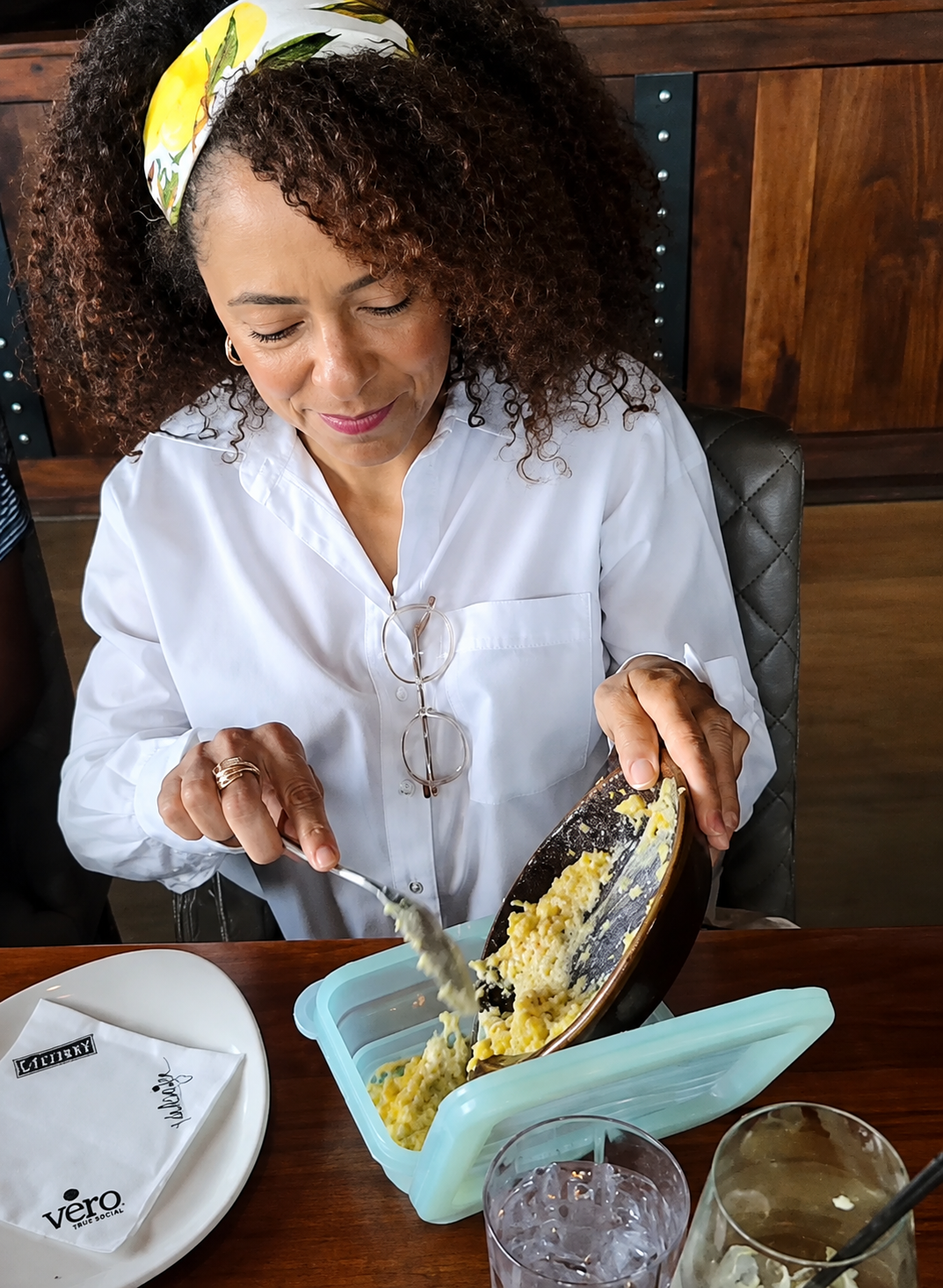
I wanted something I could keep in my bag, take to restaurants, hand to the server or pack my leftovers into, then bring home and use again and again.
The problem was, I couldn’t find what I was looking for.
Glass and stainless steel are both great materials, but they weren’t practical for what I had in mind. I needed something flexible, lightweight and convenient enough that people would actually carry it with them.
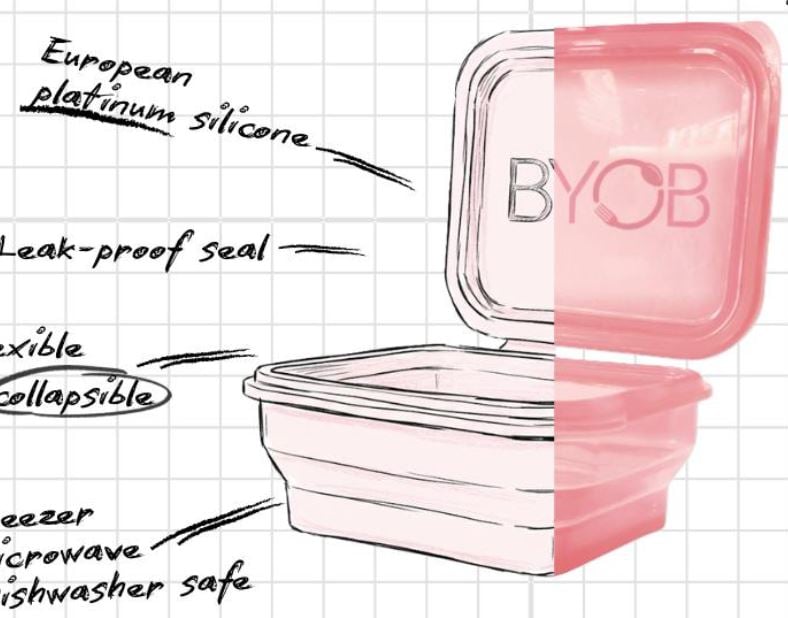
That’s eventually what led me to create BYOB (Bring Your Own Box), a collapsible reusable container designed to replace disposable restaurant to-go containers. I wanted to create the option I had been looking for and give other people a simple way to make the same swap.
Silicone seemed like the obvious material.
Except I kept thinking about that awful blue container.
Why did some silicone products feel and perform so differently from others?
That question sent me down a research rabbit hole I absolutely did not expect.
“Made from silicone” wasn’t enough information for me anymore.
I started learning about silicone formulations, curing processes and food-contact requirements.
Suddenly, words like “premium,” “food-grade” and “BPA-free” weren’t giving me all the information I wanted.
Then I discovered Germany’s approach to silicone food-contact materials.
Germany’s Federal Institute for Risk Assessment, or BfR, has specific recommendations for silicone that comes into contact with food. They address things like what can be used to make the silicone and limits on what can migrate from the finished material.
You’ll also see LFGB used when companies talk about products made to meet these German food-contact requirements.
So what’s the actual difference?
Here’s what these terms mean, in the simplest terms:
“Food-grade”  In the U.S., this usually means the company says its silicone meets the FDA’s rules for “rubber articles intended for repeated use.” (Yes, silicone is technically a type of rubber.)
Those rules basically include:
- A list of approved ingredients
- An extraction test. (The finished product is simmered in boiling water, and they measure how much comes off.)
The FDA doesn’t test or approve individual products, though. It’s up to manufacturers to make sure their products comply.
“LFGB” This is Germany’s broad food and consumer-goods law. It says anything that touches food can’t release harmful amounts of anything into it. But it doesn’t get into the details for specific materials like silicone.
“BfR” This stands for Bundesinstitut für Risikobewertung, Germany’s Federal Institute for Risk Assessment. It’s a government science agency that writes the detailed guidelines for how specific materials can meet the LFGB law. Its silicone guidelines are called Recommendation XV.
The biggest difference? BfR’s silicone guidelines add a limit on “volatiles,” aka the small leftover molecules that can off-gas or migrate into food. The silicone gets heated to about 390°F for four hours, and it can’t lose more than 0.5% of its weight. The FDA rules don’t have a limit like that.
So when companies say “LFGB silicone,” they usually mean silicone that meets BfR’s silicone guidelines.
You don’t need to memorize any of that. 
Here’s what mattered to me:
There were more specific standards I could look for than simply “food-grade silicone.”
That was the missing puzzle piece.
When I eventually developed BYOB, I insisted on silicone that met those requirements even though I was told regular silicone would be cheaper, lighter and easier to source.
To me, compromising on the material felt like selling a puzzle with one piece missing.
Thankfully, my manufacturer had a relationship with a Norwegian silicone supplier that was perfect for what I needed.
When I received the first sample, I knew we were headed in the right direction.
It was thicker. Sturdier. It didn’t have that weird smell.
It was beautiful.
Honestly, it felt a little like seeing a newborn baby.
My kitchen then became my testing lab. Dishwasher, microwave, freezer, oven, again and again.
Some of those early BYOBs are now more than three years old and still going strong.
And when a customer is eventually done with a BYOB, I have a relationship with TerraCycle so it can be returned to me for recycling.
Because to me, “reusable” should actually mean something.
But this isn’t really an article about BYOB.
It’s about what that experience taught me about buying silicone.
Is silicone plastic?
Silicone is not the same material as conventional plastic.
Silicone’s structure is different from the conventional plastics used in things like plastic food containers, bags and packaging.
That’s one reason silicone has become such a useful alternative to plastic for cookware, bakeware, baby products and food storage.
It’s flexible, durable and can handle a wide range of temperatures.
No material is perfect, but for many things in my own kitchen, I feel much better choosing high-quality silicone over conventional plastic.
Is silicone safe?
High-quality silicone made for food contact is generally considered a good option for food use.
Both the U.S. and Germany have requirements or recommendations for silicone used in food-contact applications.
But those standards aren’t equally strict, and that’s where quality shows up. In 2022, nine European consumer groups tested 44 silicone baking molds. In 36 of them, substances of concern migrated into food during testing, including the siloxanes D4, D5 and D6 (which the EU classifies as substances of very high concern).
About a quarter released chemicals at high levels or in amounts that increased over repeated use. Many of the worst performers were bought on online marketplaces like Amazon and AliExpress.
In other words: the type and quality of silicone matters for safety.
Leftover siloxanes can be reduced with an extra heat treatment called post-curing, but it’s energy-intensive and expensive, so it’s easy for cheaper products to skip. That’s the kind of shortcut BfR’s volatiles limit checks for, and that’s one of the reasons why LFGB / BfR silicone is better.
All of this reinforced something for me:
High-quality silicone is a good option, but HOW do we know if it’s actually high-quality?.
My research changed the question I ask.
I no longer stop at:
“Is this silicone?”
Now I want to know:
- “What can this company tell me about its silicone?”
- Is it LFGB/BfR compliant?
- How is it cured?
(More on those last two below.)
Is silicone safe to cook with?
Silicone designed for cooking and baking is made to tolerate heat. Of course, you should always follow the temperature limits for the specific product you’re using.
It makes me more particular about which kind of silicone I buy.
So how do you buy better silicone?
This is the part I really want people to remember.
You do NOT need to become a material scientist just to buy a spatula!
When you’re shopping, go directly to the company’s website and look at the product details.
Here’s what I look for:
1. Look for LFGB/BfR compliance.
If a company tells me its silicone meets German LFGB/BfR food-contact requirements, that gives me more confidence than simply seeing “food-grade silicone.”
It’s a meaningful sign that the company has gone further in considering the material and the food-contact standards behind it.
2. Look for platinum-cured silicone.
Platinum curing is a high-quality way of curing silicone and avoids the peroxide-curing byproducts associated with another common curing method.
For me, LFGB/BfR + platinum-cured silicone is a strong combination.
What “curing” actually means:
Curing is the step that turns silicone from a liquid to a solid. There are two main ways to do it:
- Platinum curing (also called addition curing) uses a tiny amount of platinum as a catalyst.
- Peroxide curing uses an organic peroxide instead. The problem is that breakdown products from the peroxide can stay behind in the finished product. With certain chlorinated peroxides, those byproducts can include toxic PCBs. (Not every peroxide-cured product has that problem, since chlorine-free peroxides exist, but platinum curing avoids the question entirely.)
Platinum-cured doesn’t automatically mean low in volatiles, though. Thickness and post-curing still matter. That’s why the two together (LFGB + platinum curing) are so useful: one tells you how the silicone was made, the other tells you what can leach from the final product.
Funny enough, after learning all of this, I had a lightbulb moment about my Stasher bags.
I’d used them for years and always loved the way their silicone felt.
I thought, I bet they’re using high-quality silicone too.
I looked it up.
Yep. Platinum silicone!
I’m actually glad I didn’t check earlier. It would’ve been like getting the answer to the quiz without doing the work.
3. Look for specific information.
Can’t find LFGB?
Don’t panic.
Look at what the company does tell you about its silicone, food-contact standards, intended uses and temperature limits.
Specific information gives me more confidence than vague marketing language.
4. Don’t let marketing words do all the work.
“Premium.”
“Food-grade.”
“Non-toxic.”
“BPA-free.”
Those things may sound reassuring, but after everything I’ve learned, I want more information when I can get it.
Companies that have intentionally invested in better materials are usually pretty proud to tell you about them.
You shouldn’t have to hunt forever.
And I especially love supporting smaller companies that are willing to tell customers what they’re using and why.
What about the silicone already in my kitchen?
Please don’t read this and throw everything away.
That’s expensive, wasteful and unnecessary.
Don’t panic. Prioritize.
I’d start with the products getting the most heat, food contact and repeated use.
Have an old silicone spatula and no idea what kind of silicone it is?
Maybe it becomes the spatula you use to scrape pancake batter out of the bowl instead of spending 20 minutes in a hot skillet.
An older silicone container could be used for pantry storage rather than something you repeatedly microwave.
Then, when something wears out or genuinely needs replacing, buy better next time.
That’s how I’ve approached my own home.
I didn’t learn something new and immediately replace everything.
I learned, and then I started making better choices as opportunities came up.
So, is silicone a good alternative to plastic?
For me, absolutely.
No material is perfect.
But high-quality silicone gives us a durable, reusable alternative to conventional plastic for many everyday products.
And now that I know more, I know what to look for:
✨ LFGB/BfR when I can find it.
✨ Platinum-cured silicone when I can find it.
✨ Specific information instead of vague marketing claims.
And when I can’t find the absolute best option?
I make the best choice I can with the information available.
That’s really the lesson I hope people take from my story.
I started all of this because I was simply looking for a reusable container I could bring to restaurants.
Before I was the person making BYOB, I was the person looking for it.
Now imagine if millions of us started looking a little more closely at the products we buy.
What if we supported companies doing better, asked questions when information wasn’t available and started choosing better materials when we had the option?
Companies pay attention to what customers buy.
If enough of us demand better options, companies will eventually have to make better options.
That’s my dream world.
Not perfection.
Just millions of us learning a little more, making better choices when we can, supporting companies that are doing better, and collectively raising the bar for what companies make.
Because when enough of us ask for better, better becomes the standard.