
The best non-toxic & biodegradable dish sponges in a nutshell:
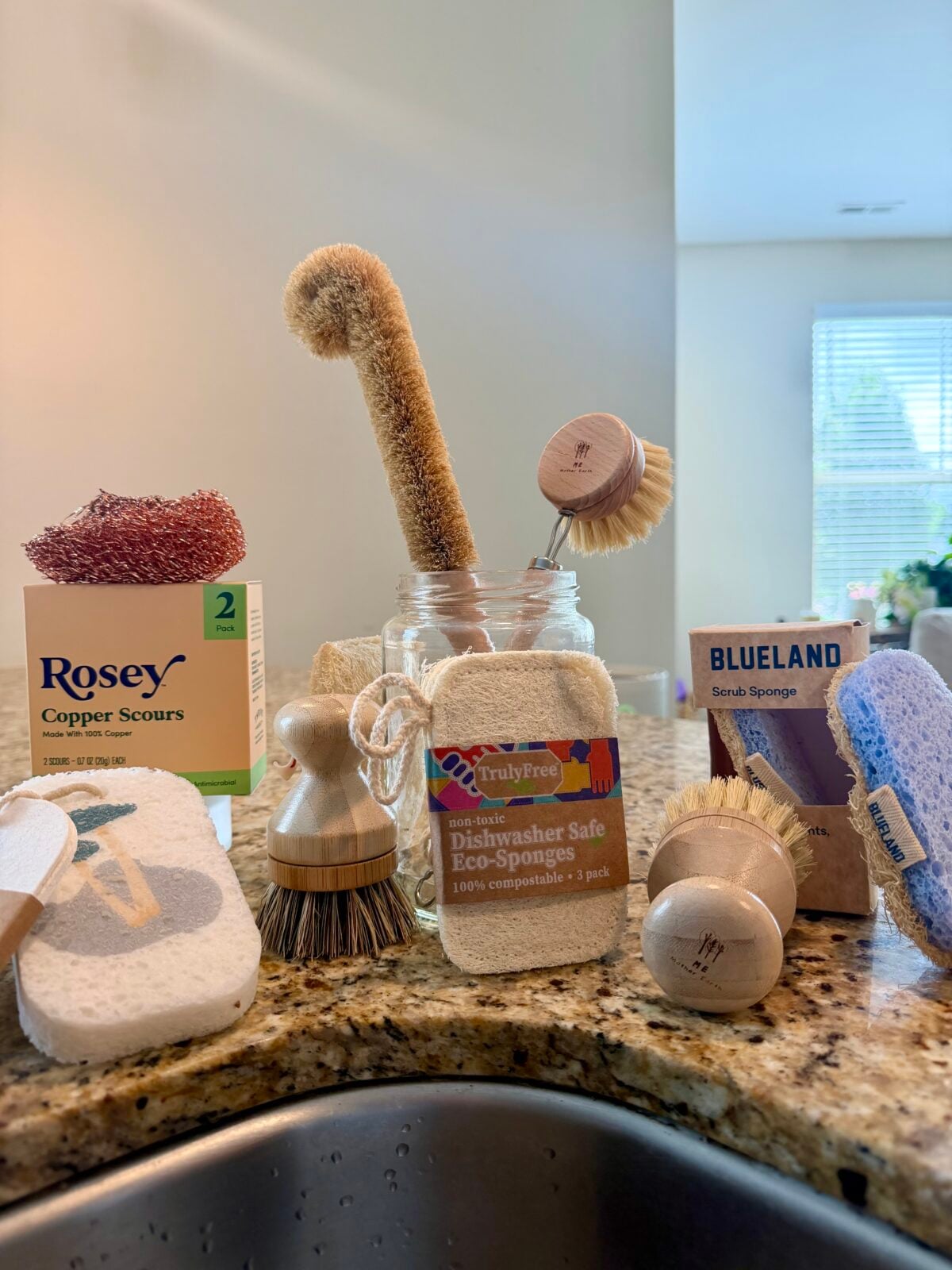
- My favorites overall: Floofah and Blueland Scrub Sponge
- Best non-toxic dish scrubber: Coconut scrubbie or Pot Scrub Handbrush from Me Mother Earth
- Best non-toxic bottle brush: Me Mother Earth
- Best paper towel/wash cloth replacement: Swedish Dish Cloths from Me Mother Earth
- Best for cast iron: Copper scrubber or chain mail
+ more options & my reviews below!
Everyone is trying to reduce the amount of microplastics in their life, and ditching your plastic dish sponge is one EASY and CHEAP way to do that.
Those plastic sponges break down as we use them, washing tiny pieces of microplastics down the drain and into the waterways and environment. A lot of those microplastics end up in our tap water, and many municipal water treatment facilities are not equipped to filter them out.
A 2026 study out of Germany looked at how much plastic shed from dish sponges from regular use and found that 0.68 to 4.21 grams of microplastics per person per year were released, depending on sponge type. (Some of the sponges they used contained higher percentages of plastic than other ones.)
When the researchers extrapolated this data, they found that if every German household used the worst sponge, it would equate to ~355 metric tons of microplastics per year. 😳
At this point, there is really no reason to continue using these plastic Scotch-Brite style dish sponges when there are plenty of great non-toxic and plastic-free alternatives available.
I’ve reviewed a bunch of different kinds for this article and I’m going to tell you which ones were my favorite and which ones weren’t. I’ve got several different options for you, from soft sponges to heavy duty scrubbers.
Related:
What this guide covers:
- DON’T GET DUPED! A lot of “biodegradable” dish sponges are actually NOT.
- I tested 11 non-toxic dish sponges. Here’s what I’d re-buy (and what I wouldn’t)
- Floofah
- Blueland Scrub Sponge
- Me Mother Earth
- Rosey by Thrive Market Copper Scour
- Truly Free Eco Sponges
- Even more options for plastic-free & biodegradable kitchen sponges:
- Natural materials to look for in your non-toxic kitchen sponge
This guide contains product recommendations, and we may receive compensation through affiliate links or editorial fees. As always, we only make recommendations that are genuine!
DON’T GET DUPED! A lot of “biodegradable” dish sponges are actually NOT.
You can easily get fooled by the “eco-friendly” dish sponges out there.
I have purchased a pack of sponges before thinking they were compostable and plastic-free, only to find out later that they actually weren’t.
Take these, for example. They’re one of the most popular options on Amazon and are marketed as “natural,” “biodegradable,” “eco-friendly,” and “non-toxic.”
But then when you actually look at the end-of-life directions, it tells you to separate the two halves and compost only the cellulose part. The coconut scrubber part has to be thrown away.
But why? Coconut husk should be compostable; why would they tell you to “discard the scrubber responsibly” instead of put it in the compost with the cellulose part?
My guess is that the coconut husk is actually mixed with synthetic fibers… They just don’t tell you that.
If you look at this “CocoMesh Scrubber” from Scrub Daddy, they are more honest about it. They say it’s a mix of coconut husk + recycled plastic. Same with the options from Full Circle. Their sponges appear to be ‘eco-friendly’ as well, but they are honest about the fact that they are mixed with recycled plastic and they cannot be composted at the end of their life.
I suspect that other brands are doing the same thing, just not being as transparent.
I also think there could be synthetic glues involved to not only hold the two halves together but also to hold the coconut fibers together as well.
Similarly, you have to be careful about some of the metal scrubbers out there too. Check out this copper coated scrubber from Scotch-Brite, for example; they’re made with copper over plastic.
I tested 11 non-toxic dish sponges. Here’s what I’d re-buy (and what I wouldn’t)
Floofah
Materials: Natural luffa plant + wood-based cellulose
Home compostable? Yes
Cost: $3.80 per sponge
How long do they last? Recommended you replace them every 4-6 weeks.
Dishwasher safe? Yes. You can also put it in the microwave or boil it for sanitization.
This is one of my favorite options overall. It feels like the most like those conventional Scotch-Brite style sponges that you may be used to.
Floofah is a small business that makes great plastic-free loofahs for the shower, but they also have a kitchen sponge option and a dish sponge now too.
I originally reviewed the kitchen sponge (which is essentially the same thing as the shower loofah, just a different shape that makes it easier to hold for dishwashing). I wasn’t a huge fan of this one for washing dishes, honestly. It’s too stiff for me; It doesn’t bend well enough around the ridges of mugs or the crevices of my blender.
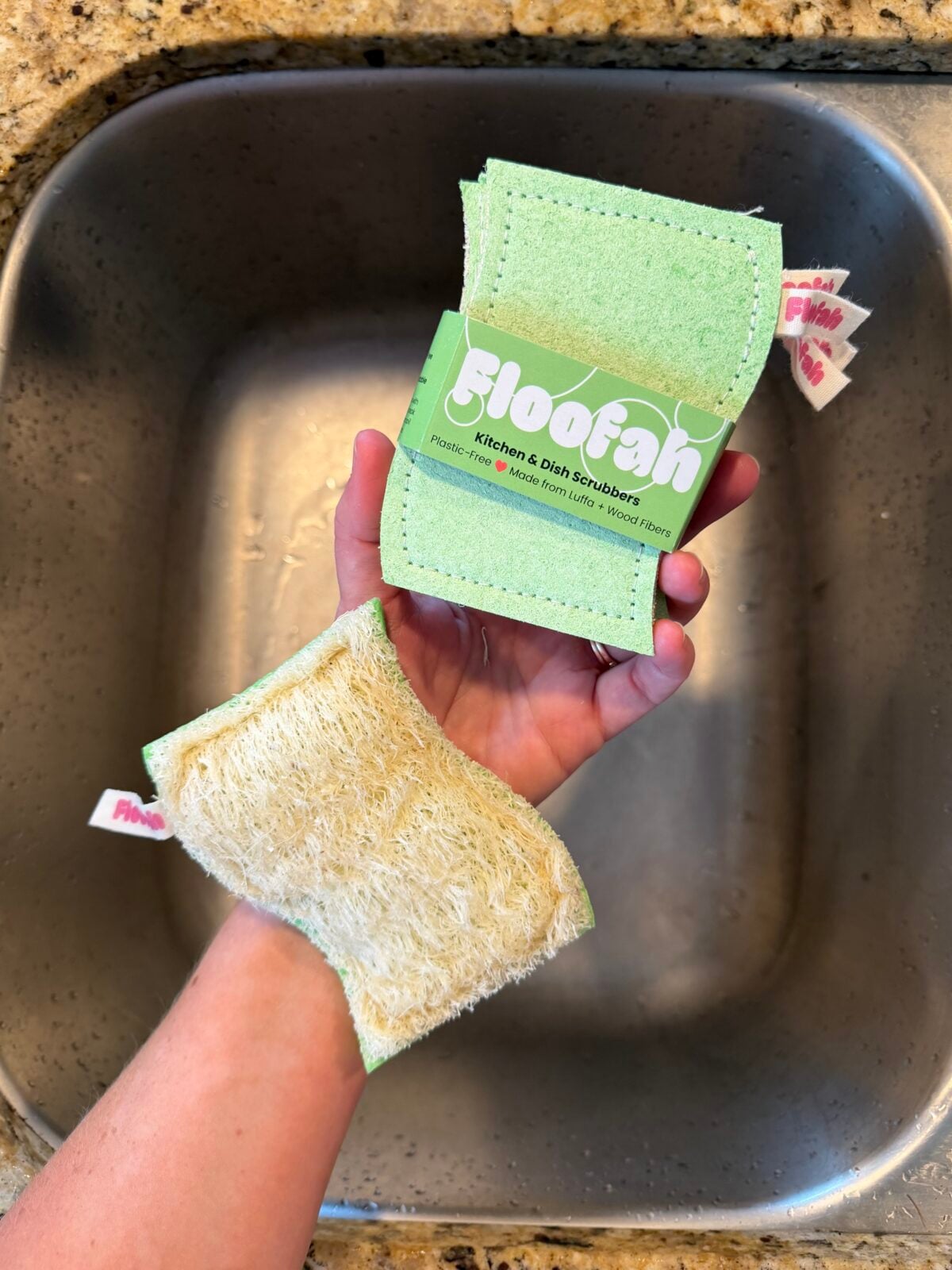
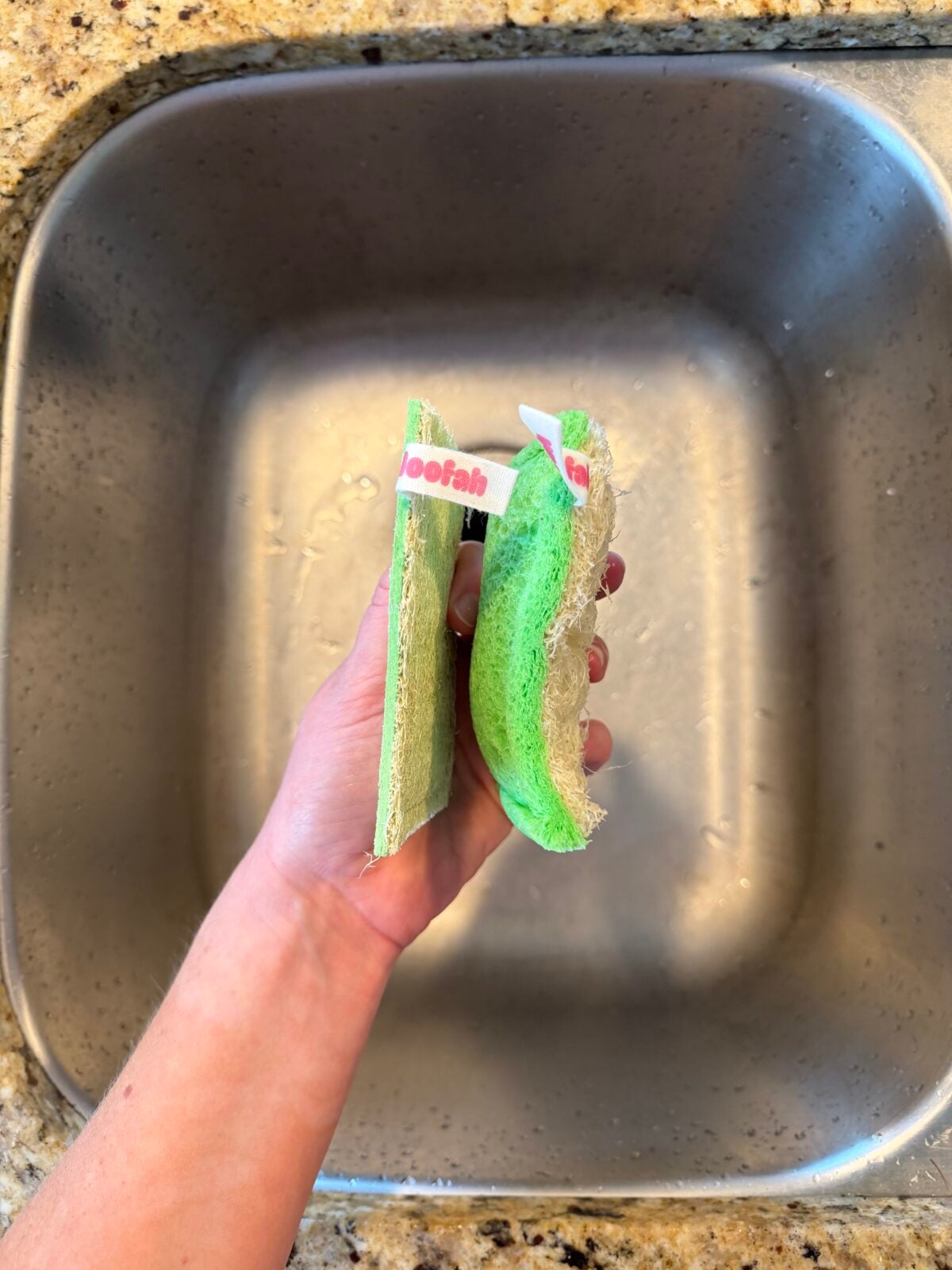
But I’m happy to say that they JUST launched a brand new dishwashing sponge and this one is that is SO much better. It’s two-sided (a loofah scrubber on one side and a plant-based sponge on the other) and is totally compostable. It’s a lot squishier than the one I tried before and so much better for cleansing dishes. This is the green one pictured above. (It also comes in pink.)
Would I re-buy it? Yes, I would definitely re-buy the two-sided green/pink one.
I would not rebuy the kitchen sponge for dishwashing (though I’d use it as a regular loofah in the shower).
Blueland Scrub Sponge
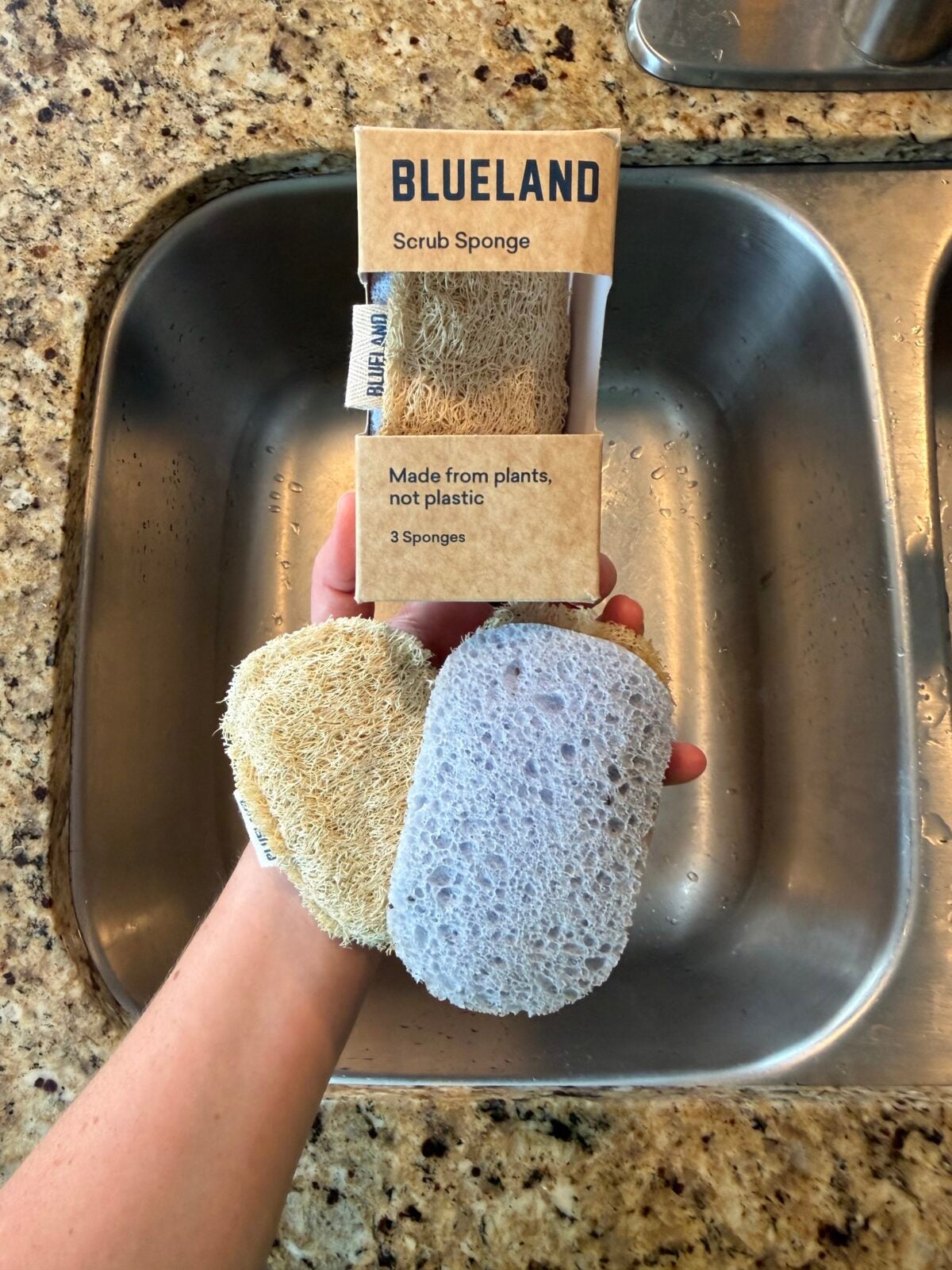
Materials: Plant-based cellulose, natural luffa, and cotton
Home compostable? Yes
Cost: Starting at $3.73 per sponge (depending on how many you get)
How long do they last? They say you may need to start replacing them after 2-6 weeks. (But mine have lasted much longer than that.)
Dishwasher safe? Yes, you can put it in the dishwasher or boil it to clean and sanitize
This one is very similar to the Floofah one.
It’s squishy and flexible enough to get into cups and crevices, but it also has scrubbing power too.
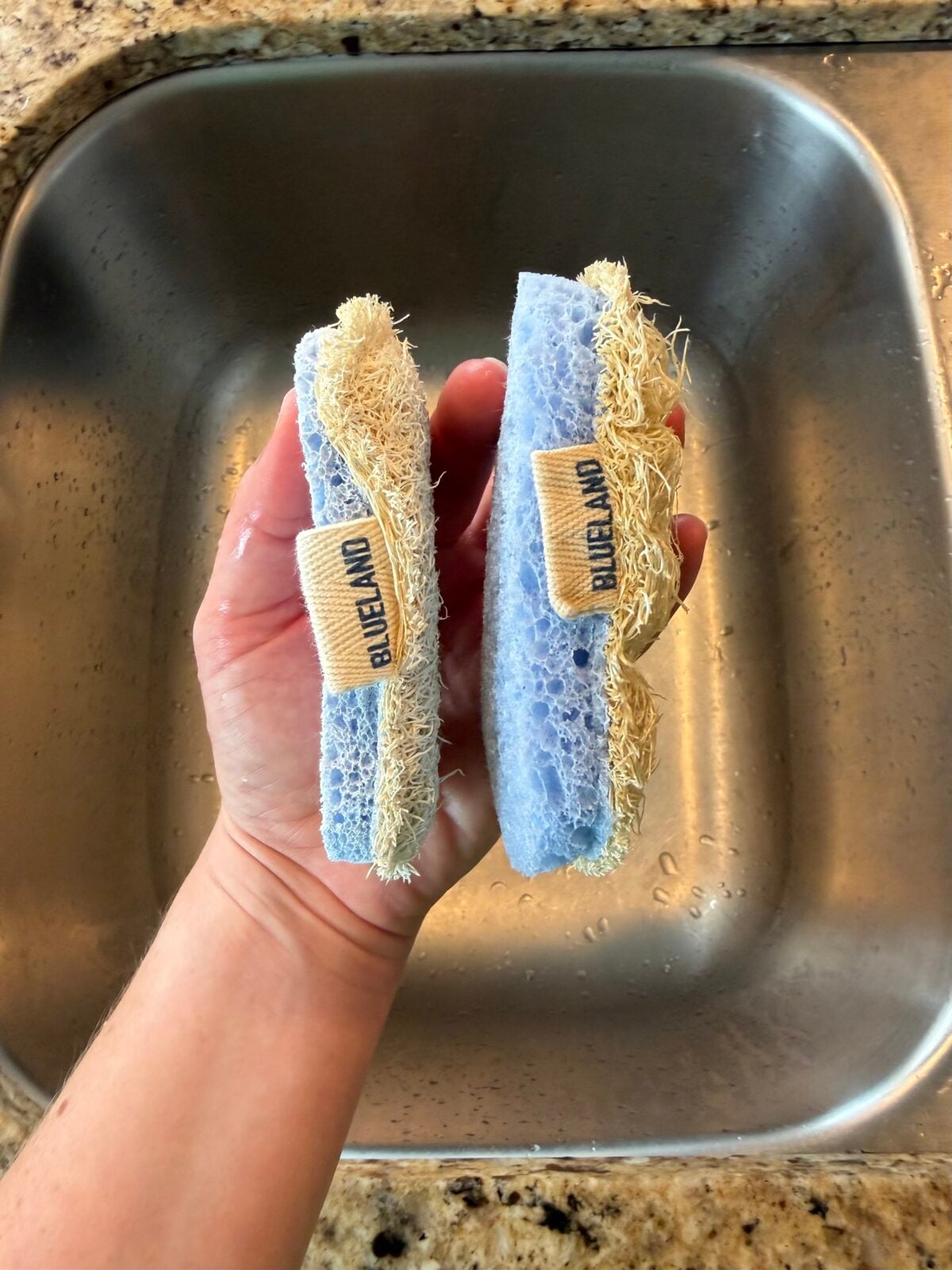
As you can see, it’s dual-sided, so you’ve got the softer cellulose sponge on one side and the natural luffa on the other for scraping away the tougher stuff. And the pieces are even sewn together using cotton thread instead of glue so that the entire thing is truly plastic-free.
If you’d rather just have the soft sponge without the luffa side though, they have a pop-up sponge option too. They also carry a Cloud Cloth, which is a reusable paper towel alternative that’s made from compostable cellulose and cotton.
The only real downside to these is that they’re not as effective for the super tough stuff. If you have a super caked-on mess, you might need something with more scrubbing power. I personally will keep something else on hand, like a coconut and/or metal scrubber (see below), in addition to the Blueland sponge.
Btw, here’s my full Blueland review, which includes their other products like cleaning sprays and dishwasher tablets.
Would I re-buy it? Yes, definitely.
Me Mother Earth
Materials: Beechwood, bamboo, sisal, luffa, cellulose
Home compostable? For the most part, yes, but some of them have metal parts which will have to be removed and then recycled.
Cost: $2.33 (per sponge) – $30 (bundle)
How long do they last? Depends. The brushes will last a LONG time (and you can get replacement heads to make the handles last even longer), while the cellulose sponges will last a couple of months.
Dishwasher safe? Yes, but they actually recommend cleaning by either soaking in vinegar or boiling. Some of the options contain metal so cannot be put in the microwave.
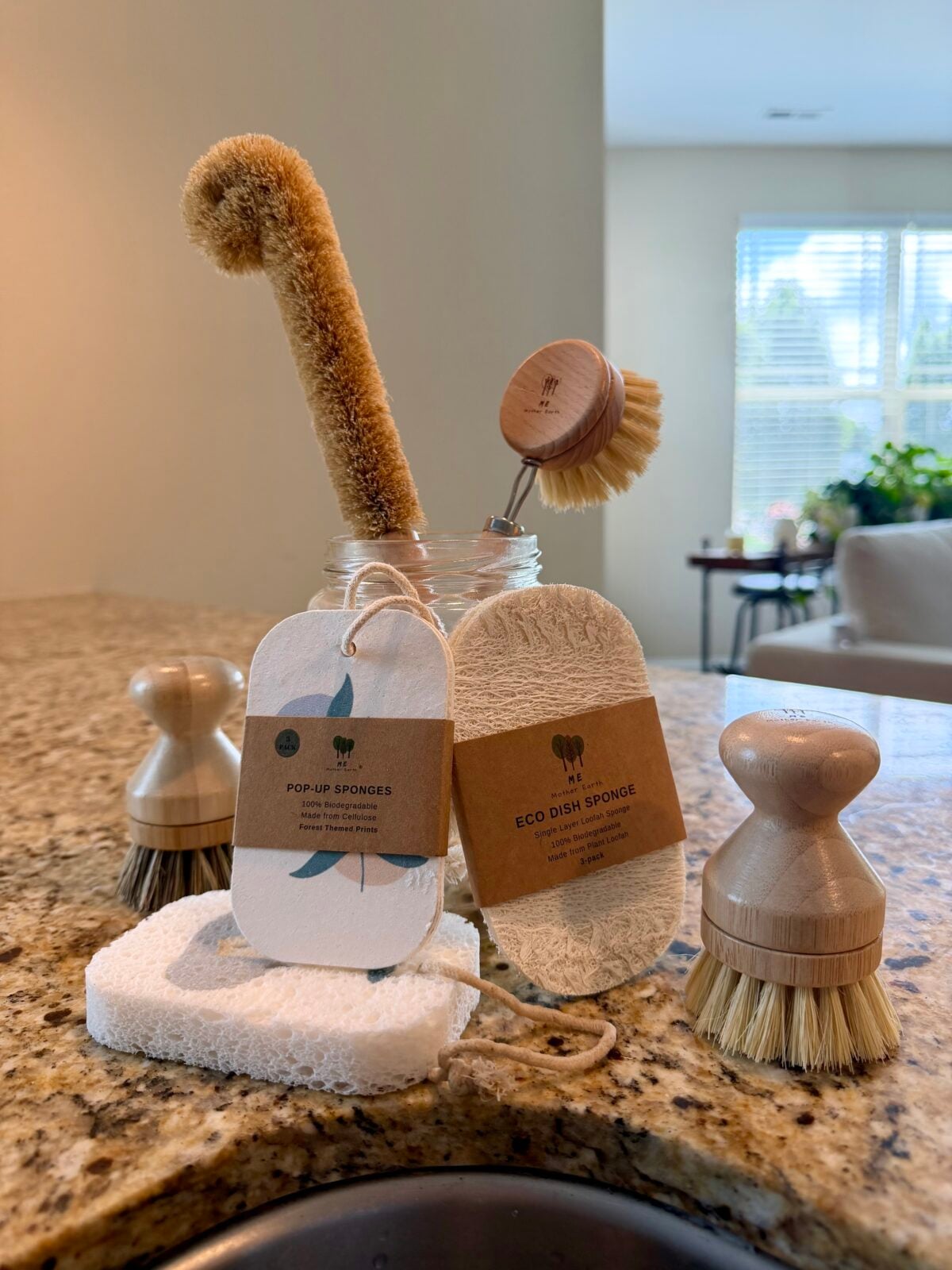
Me Mother Earth is one of the best places to get plastic-free sponges and brushes because they have so many to choose from.
Here are the ones I’ve tried so far and what I think about them:
- Pop-up Sponges: First of all, these are so cute; they have designs like mushrooms and naturescapes. They start flat but then expand into a soft sponge when you get them wet. These feel very similar to your regular kitchen sponge, but they do not have a scrubby side. So they’re really flexible and easy to use, but you’ll need something else for tough messes. I like that they added the cotton string for hang-drying.
- Round Coconut Scrubbie: I love a coconut scrub brush. There was a time when I used only this for months. It has enough scrub power that it can clean off pretty much any mess, but it’s still soft enough that you can use it on pretty much any surface. I like the circle shape too; the way it fits into my hand makes dishwashing easy. It’s a great option for cast iron and other cookware.
- Bottle Scrub Brush: When you need to wash baby bottles, water bottles, tall glasses… this is the one. The handle is made from wood and the bristles are made of coconut husk. I will probably always have one of these on hand because it can get to places that no other sponge can.
- Single Layer Eco Dish Sponge: This one looks like it’d be similar to the Floofah and Truly Free ones below, but it’s actually a lot thinner. This makes it a lot more flexible and easier to work with, so I like it. They do have a Double Layer one as well, which I haven’t tried but I suspect is thicker and less flexible. They’re both made of luffa plant.
- Brushes: You’ve got multiple different brushes to choose from, all of which have replaceable heads:
- The Pot Scrub Handbrush has a bamboo handle and a mix of palm and sisal bristles. These are thicker and more rigid so they give a more heavy duty clean.
- The Multipurpose Bamboo Handbrush is a softer version; it uses only sisal bristles.
- The Beechwood and Sisal Dish Brush has a long handle. The handle is made of wood and the bristles are made of sisal to give it moderate scrubbing power. Not super soft, but not heavy duty either.
- They also have a Two-in-One Multipurpose Scrub Brush which I haven’t tried yet. It’s larger and comes with two different types of bristles—one softer and one tougher. I personally wouldn’t really use this one for washing dishes, but I would use it for things like cleaning the bathtub.
- Swedish Dish Cloths: A lot of people love Swedish dish cloths as a replacement for paper towels or wash cloths. They’re fun because they usually have pretty designs on them. They won’t last as long as a regular wash cloth, but they’ll usually last a few months (and then can be composted afterward). These ones are made of a mix of wood pulp and cotton.
Would I re-buy? Yes, I’d be likely to re-buy most of these. My favorites are the Pop-Up Sponges, the Coconut Scrubbie, and the Bottle Brush. The one I’d be least likely to re-buy is probably the Beechwood Dish Brush with the handle.
Rosey by Thrive Market Copper Scour
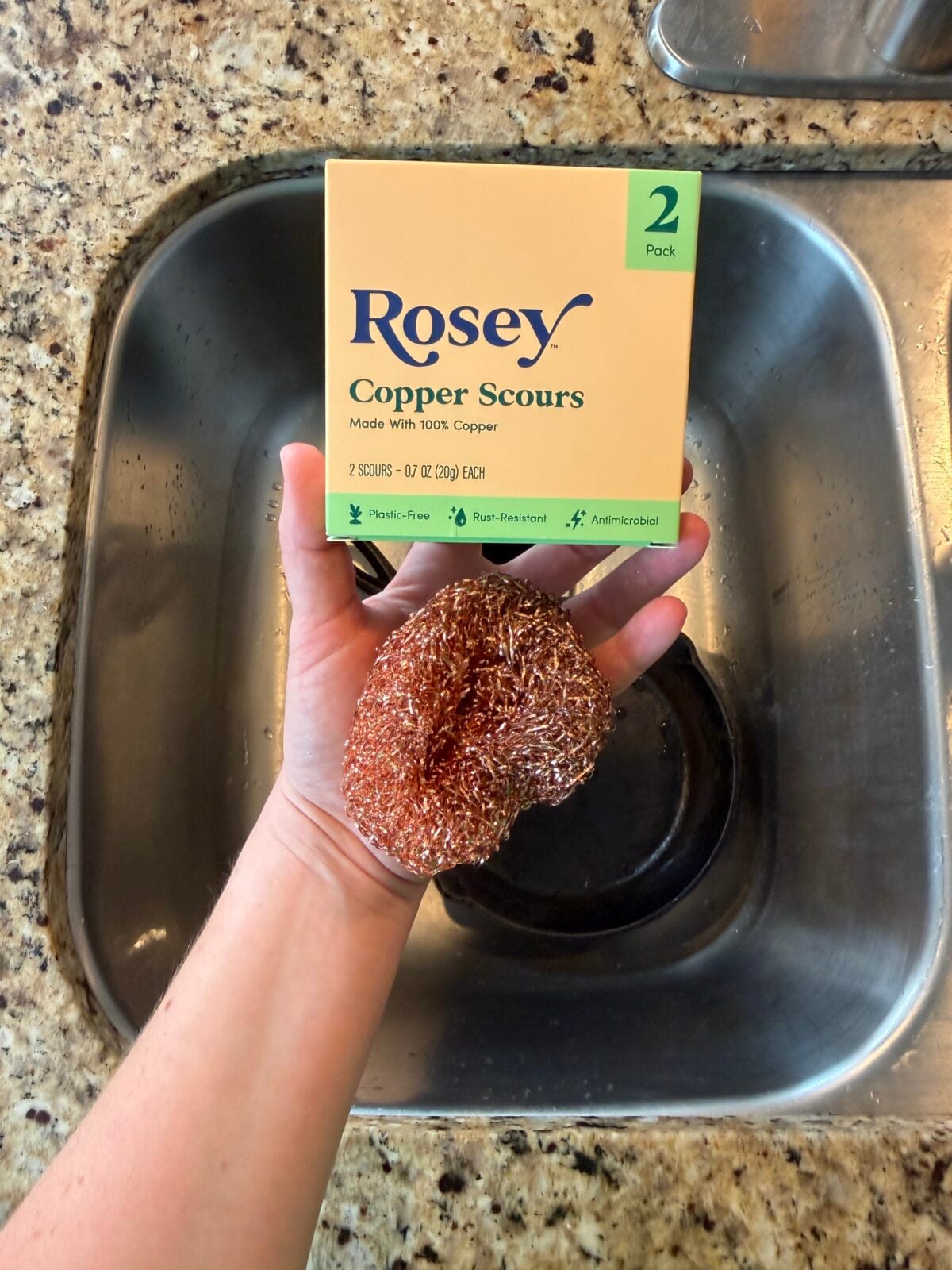
BTW, if you’re not a Thrive Market member, you can get a similar option from Full Circle on Amazon or Grove. Or here is one from Zero Waste Store. Just make sure whatever copper scrubber you choose that it is 100% copper. Some brands out there just offer copper-coated scourers that have plastic underneath!
Materials: 100% copper
Home compostable? No (but it can be recycled)
Cost: $2.50 per sponge
How long do they last? Can vary widely, from a couple of months to a year
Dishwasher safe? Yes.
Would I re-buy it? Yes.
I tend to like copper over stainless steel mesh scrubbers for a few reasons:
- It’s softer so you can use it on more surfaces. (Although you should not use it on things like non-stick cookware or enameled cast iron.)
- It doesn’t rust or splinter, so you don’t have to worry about it poking your hands.
- It has antimicrobial properties, which can help prevent smells and stuff.
I still use the softer scrubbers like the coconut scrubbie or the pot scrub handbrush a lot with my cast iron. But then if I need something stronger, I’ll use copper.
The other option I really like for cleaning cast iron is chain mail. Field Company has a cast iron care kit that includes a regular chain mail scrubber, or Lodge has one that has silicone inside to give it more structure.
P.S. Here are some more things we like from Thrive Market.
Truly Free Eco Sponges
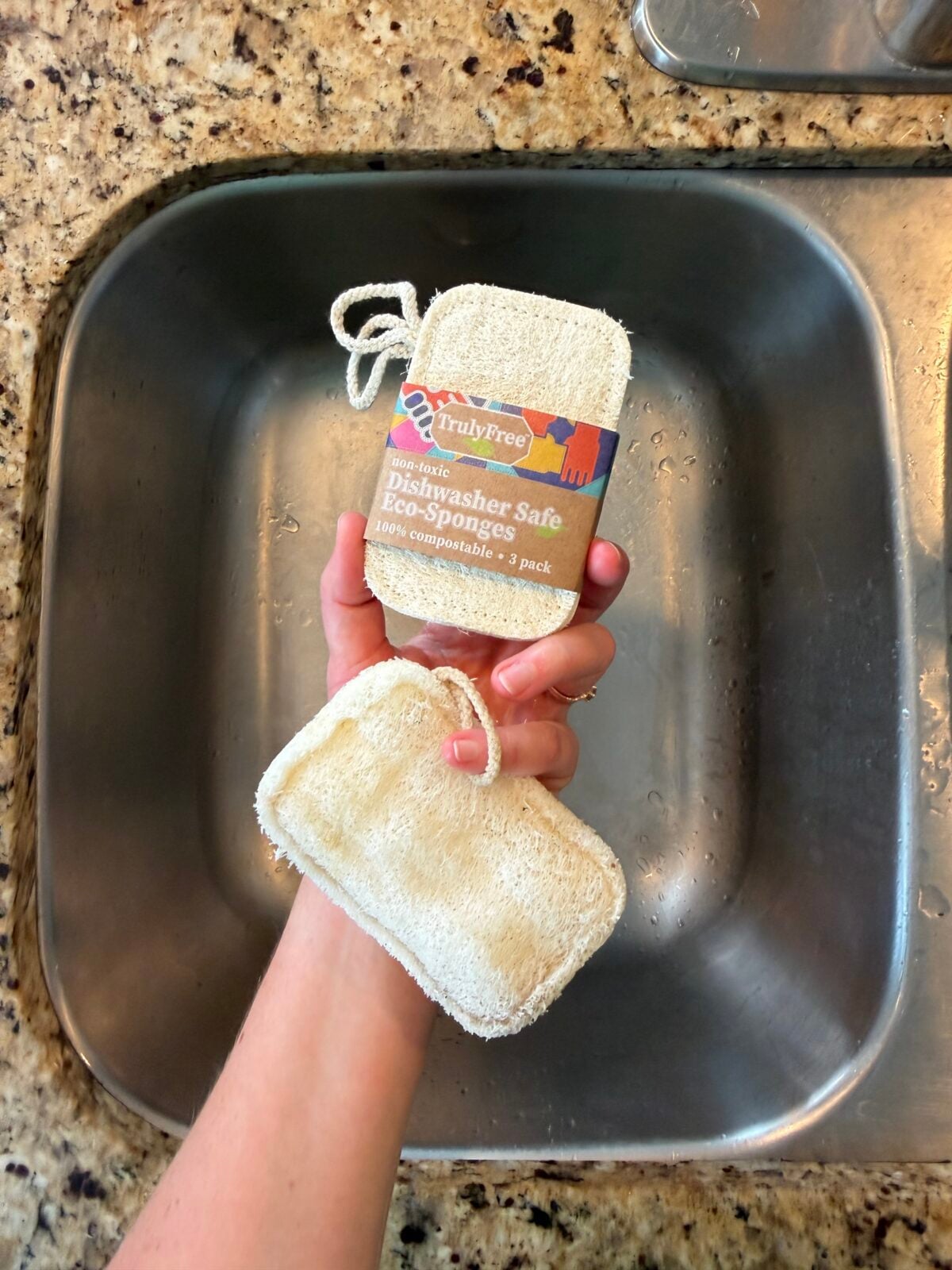
Materials: Luffa plant
Home compostable? Yes
Cost: Starting at $3.33 per sponge (depending on how many you buy)
How long do they last? They say “approximately 3-4 weeks, depending on usage.” Once again, I have used mine a lot longer than that.
Dishwasher safe? Yes, microwave & dishwasher safe
I’m not crazy about this one… It’s just too stiff to use as a sponge. While I really like that it’s 100% natural, it’s just difficult to wash certain dishes because the sponge doesn’t bend enough.
I do appreciate that it has a little hook on it though. It makes for better drying and therefore is less prone to getting moldy.
Would I re-buy it? Probably not. (I like a lot of Truly Free’s other products, though.)
Even more options for plastic-free & biodegradable kitchen sponges:
- Free the Ocean: They sell plastic-free coconut dish scour pads.
- Zero Waste Store: They have a lot of the same options as Me Mother Earth does, including plastic-free dish sponges, Swedish dish cloths, cellulose sponges, and copper scours.
- Plantish: Another store that has a variety of brushes & sponges! THEFILTERY15 will get you 15% off.
- EcoRoots: They don’t have quite as many options, but they also have dish brushes and loofahs.
Natural materials to look for in your non-toxic kitchen sponge
Here are your usual options:
- Natural luffa plant: This is what a luffa plant looks like; it’s actually a gourd from the cucumber family! As you’d probably guess, this is where the term “loofah” that we use for our shower sponges comes from. This is a totally natural and compostable material that requires little to no processing to turn it from a raw plant into a sponge. It has a moderate amount of scrubbing power—more than a soft cellulose sponge but not as much as a metal scour.
- Coconut husk (coir): This is the coarse, stringy fiber from the outer husk of a coconut. It’s a byproduct that would otherwise be waste. It’s naturally stiff, making it a really great option for plant-based scrubbers (works for stuck-on food), but it’s still soft enough not to scratch most cookware. It’s totally natural and compostable, with minimal processing.
- Cellulose: This is a soft, highly absorbent, and biodegradable material that’s made from wood pulp. It’s the closest plant-based stand-in for a classic synthetic sponge. It has the least scrubbing power, but it’s also the most flexible so it can get into cups and grooves well. It’s often blended with cotton to make Swedish dishcloths. Just make sure you buy cellulose products that are actually 100% plant-based and do not have added synthetics, non-biodegradable dyes, or antimicrobial treatments.
- Sisal: This is a stiff, scratchy natural fiber from the agave plant. It’s durable with strong scrubbing power (similar to coir) and is usually used for scrub brush bristles.
- Metals (copper or steel): Solid metal scrubbers are plastic-free and can potentially last forever, depending on what kind we’re talking about. Copper is the softer, more versatile metal—it lifts grime without scratching most surfaces—while stainless steel and chainmail are more aggressive and best saved for cast iron and heavy-duty jobs. Both are inert, food-safe metals; just match the hardness to your cookware and keep steel off coatings and enamel. They’re obviously not compostable, but can be recycled.
- Bamboo & wood: These materials are usually used for the handle of scrub brushes rather than the scrubbing surface. Bamboo is fast-growing and renewable, while hardwoods like beech are sturdy and long-lived; both are compostable once you remove any metal parts. The bristles paired with them are often plant fibers like sisal, tampico (agave), or coir.



To clarify my other comment here: With a scrub sponge, I hate to ditch the whole thing when the sponge goes bad but the scrubber side is still going strong.
Excellent, Abbie. Thanks so much. I prefer a sponge-less scrub pad. Because sponges wear out sooner than scrub pads do. Hate to ditch the whole thing when only the sponge is history. If that makes sense.
I’ll now absorb your whole post here!
I hear you! Probably just comes down to personal preference. 🙂