
You’ve probably seen a Berkey water filter at some point—it’s that big black metal countertop filter that looks something like this:
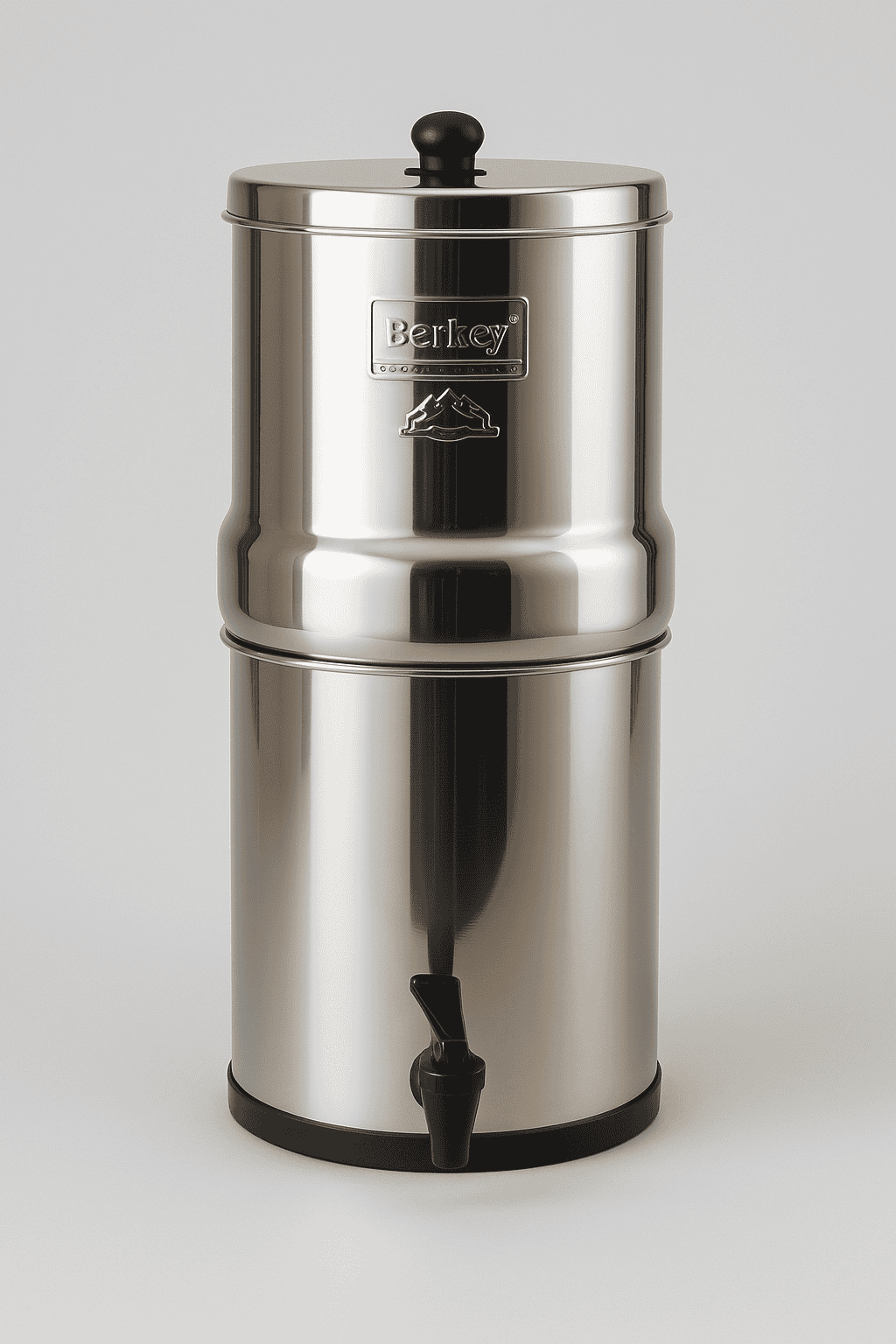
Because it’s gravity-fed (requires no electricity) and has a long filter life, Berkey was originally marketed toward emergency preppers and people living off the grid. But now, it’s also become a top-choice for many conscious consumers who want to filter their drinking water at home.
For decades, Berkey offered filters in various sizes, including the “Big Berkey” and the “Travel Berkey.” The outer portion that holds the water is made primarily out of stainless steel, and the filter itself is a “carbon composite”.
In recent years, Berkey has been embroiled in a fight with the US EPA and has had to stop selling their replacement filters.
There have even been rumors that Berkey has shut down completely. The whole situation has been very confusing for customers.
In this article, I’m going to clear it all up so that you can decide whether or not Berkey (and BOROUX!) filters are something you want to use in your home.
The Berkey Business Model Makes Things Confusing
The owner and manufacturer of Berkey water filters is called New Millennium Concepts Ltd (NMCL). They have been making Berkey water filters in the United States since the late 1990s.
But NMCL doesn’t actually sell Berkeys directly to consumers. Instead, they work through a dealer model.
Authorized dealers such as “Big Berkey Water Filters“, “USABerkeyFilters.com“, and BerkeyFilters.com would sell the water filters and accessories directly to customers. All of these dealers are technically completely separate companies, even though they’re selling the same products.
(You might be familiar with a similar model that wireless providers use. If you pull up to a Verizon store, it could be an actual Verizon corporate store, or it could be an Authorized Retailer, such as Cellular Sales. The biggest difference between this model and the Berkey one is that Verizon Corporate actually sells Verizon plans to customers, whereas New Millennium Concepts doesn’t—it only distributes its products through dealers.)
We’re going to get back to this issue with the dealers in a minute.
What’s the Controversy With Berkey and the EPA?
In late 2022 and early 2023, Berkey found itself in a legal battle with the US Environmental Protection Agency (EPA) over a classification issue.
Basically, the EPA said that because of the fact that Berkey’s filters claimed to remove viruses and bacteria, they should actually qualified as a pesticide under the Federal Insecticide, Fungicide, and Rodenticide Act (FIFRA).
Pesticide Devices vs. Pesticide Substances
Under FIFRA, there are two different categories that products can fall under:
- A pesticide device is a mechanical or physical instrument that’s intended to control ‘pests’, but not actually kill them. Most water filters that claim to deal with microorganisms are pesticide devices because they filter out things like bacteria and viruses; they don’t actually kill them.
- A pesticide substance, however, is something that is meant to more explicitly kill a ‘pest.’ Think of your stereotypical pesticides like chlorpyrifos or glyphosate.
Both pesticide devices and substances are regulated under FIFRA, but the rules are much stricter for substances.
Pesticide devices have to be made in an EPA-registered facility, but the products themselves do not have to go through formal registration.
Pesticide substances DO need to be registered with the EPA.
The problem with Berkey arises with how they were filtering out microorganisms and the claims they were making.
Part of their filtering process involves silver. As we know, silver has antimicrobial properties. It can actually kill bacteria.
Other water filters that deal with microorganisms—like Lifestraw or Epic—get rid of bacteria and viruses through filtering, not killing. They use membranes and filtration media to essentially “catch” bacteria. They don’t kill it.
So, you can see now why the silver in Berkey filters—combined with the company’s claims that the Berkey can get rid of microorganisms—moved them from pesticide device territory into pesticide substance territory.
In 2022 and 2023, the EPA issued several Stop Sale, Use or Removal Orders (SSUROs) on New Millennium Concepts and at least one big Berkey dealer: James Enterprise Inc., or JEI. JEI was the owner of BerkeyFilters.com.
This basically meant that all Berkey dealers had to stop selling their filters. (It seems they were allowed sell through the stock they already had, but they couldn’t make any new ones to sell.)
I’m still not sure why or how Berkey was allowed to sell their filters for so many years and why the EPA all of a sudden decided to enforce this rule when they did. New Millennium Concepts says it has to do with COVID-19. They say, “We have been informed that the real issue is that because of COVID-19, the EPA does not like the fact that Berkey® filters are capable of removing viruses from your water.”
In August 2023, NMCL filed a lawsuit against the EPA to prevent them from classifying Berkey filters as a pesticide. In November 2024, NMCL’s case was dismissed due to what the court said was NMCL’s “lack of standing”. NMCL appealed, and then the Court of Appeals denied them. At the time of publication, the suit is still in progress and the Fifth Circuit Court of Appeals. So we will have to wait and see how this plays out in the long run.
Okay, so why didn’t Berkey just register their water filter as a pesticide substance in order to get into compliance with FIFRA and make the EPA happy?
My best guess is that it probably would have been very expensive and time-consuming for them, potentially costing them hundreds of thousands of dollars and several years.
NMCL and Berkey dealers have argued that the EPA has unfairly picked on them and that the EPA is not treating other water filters that use silver the same way. This may in part be true. That often happens in situations like this, where the “big guy” gets singled out. Waterdrop is another brand that has a gravity-fed filter that’s very similar to Berkey and it doesn’t appear they were targeted by the EPA. However, as I write this, Waterdrop says their silver is only there to prevent growth on the filter, not to actually filter microorganisms from the water. I have no idea whether this is always the way Waterdrop has positioned its filters or if they learned from Berkey’s mistake and changed their claims in recent years.

BerkeyFilters.com (JEI) Restarts as BOROUX
JEI, one of Berkey’s biggest dealers and the owners of BerkeyFilters.com, decided they weren’t going to wait around to see if New Millennium Concepts would win their lawsuit and they would be able to sell their filters again.
Instead, JEI decided it would be better (faster and cheaper) to restructure their business, change some of the claims, and relaunch under a new name.
This is part of what has caused all of the confusion about whether or not Berkey has gone out of business. BerkeyFilters.com (aka JEI)—one of the major distributors—did dissolve the Berkey part of their business. But NMCL, the actual owner of Berkey, is NOT going out of business. They are still hoping to win their case against the EPA and get back to selling its filters.
BOROUX was actually a drinkware company owned by JEI, but in 2023, it became a water filter company too. According to BOROUX, their filters are essentially the same as Berkey’s. The only thing they’ve changed is the claims they make.
They no longer claim to filter out microorganisms and therefore they’re not subject to the FIFRA regulations for either a pesticide device or substance.
They DO still contain silver, but now instead of the filter being part of the actual filtration process, they say that it’s used “to prevent the filter from degrading while treating municipal tap water.” So basically, their filters are no longer advertised as being able to filter out bacteria and viruses, and they are now only recommended for use with tap water that’s already been disinfected. The silver that’s in it is now only used to extend the life of the actual filter and to keep bacteria from growing on that, not to actually filter out or kill microorganisms in the water.
Things continue to be murky here.
BOROUX says on its website that the Berkey filter formulation “is still in use, but from a new unrelated company named BOROUX.”
Then they say:
“Disclaimer: BOROUX is not in any way affiliated with, endorsed by, or sponsored by Berkey. References to Berkey products in this release are merely to explain changes in the availability of certain filters.”
But personally, I find this framing a bit misleading. As I’ve mentioned, JEI is the parent company of BOROUX, the same parent company that used to distribute Berkey and was issued with the stop-sale order from the EPA. The actual people behind it are the same. They say themselves they’re using the same formulation for the filter. So I personally think that to say it’s “unrelated” is a stretch.
I understand that the team is trying to distance itself from Berkey in order to start fresh without the EPA baggage, but in my opinion, this kind of language just further confuses customers. You can decide for yourself what you think.
So, Can You Trust BOROUX? Is It a Good Filter?
One of the biggest complaints that consumers had about Berkey was that they did not have any third-party testing or certification.
Not only that, but several independent testers over the years have found that Berkey’s filters don’t really hold up to their claims, and that they don’t really filter out what they said they do.
(If you dig into the details of those independent tests, you’ll also see some inconsistencies in which contaminants were detected post-filtration. This inconsistency leaves me with some doubt about how well the filter actually works across time and location.)
Considering that the BOROUX filters appear to be the same as the Berkey ones, we can be relatively confident that the filtering capabilities haven’t changed much. This seems to have been verified by Brian at Water Filter Guru who did his own before and after tests on BOROUX and did not get amazing results. Fluoride was barely reduced at all, and there was actually more cobalt in the water after it went through the filter than there was before. (Cobalt is a heavy metal that does come with health risks.)
Note that BOROUX does not currently claim to adequately filter out fluoride, and they say they are working on a fluoride filter.
Back to the third-party certifications…
In a video on their website, Parker Emerson (BOROUX’s Brand Director) said “We’re able to bring you what you’ve been asking for for years. That is—verified test results, certifications, and transparency.”
At the time of this publication, they have one certification and it’s not even for the product’s filtration capabilities. They are certified by the Water Quality Association to meet the NSF/ANSI Standard 372, which means the components of the water filter are verified to be very low in lead (no more than 0.25% lead / 0.2% for solders and fluxes).
Again, this certification has NOTHING to do with the product’s ability to actually filter anything out. All it’s saying is that the device itself is low-lead.
And while that’s certainly a good thing, I think the way BOROUX is communicating this certification is misleading.
Okay, now let’s look at BOROUX’s lab tests. They publish the results of their IAPMO (International Association of Plumbing and Mechanical Officials) tests on their website for many different contaminants.
I really like to see this. The more independent lab tests that a company can provide consumers, the better.
But why are they not certified? If they’ve gone through the trouble of getting all of these tests done, why did they not get the correlating certifications? IAPMO is a certifying body for NSF/ANSI, so they could have gotten the certifications when they got the testing done…
It could potentially be an issue of funds. It costs a lot of money to get and maintain certification. I have been told by other small water filter companies that getting and maintaining certification is “ridiculously expensive”, and I think that’s a valid consideration.
Or, is it because their test results didn’t meet the standards for certification? I reached out to the BOROUX team and asked them why they got the tests done but still aren’t certified. They pretty much gave me a non-answer:
Thanks for reaching out and for your interest in our BOROUX foundation Black Filters. I get where you’re coming from with your question about certifications. Our filters have undergone testing by IAPMO R&T Lab NJ, an ISO/IEC 17025 accredited laboratory, which verifies their ability to reduce or remove a wide range of contaminants effectively. Although we haven’t pursued NSF/ANSI certifications like 42, 53, 401, or P473, the testing we have undergone demonstrates our filters’ performance capabilities.
We are always evaluating additional certifications, so your feedback is helpful as we consider future enhancements.
You can explore the detailed lab test reports which provide in-depth insights into what our filters can reduce. Here are some links to the lab test reports:
I hope this helps clarify your concerns, and please feel free to reach out if you have more questions.
So then I used AI to try and get some more information about why BOROUX’s test results are not leading to certification. I compared the test results from BOROUX’s website to the requirements for several different NSF/ANSI standards.
So then I used AI to try and get some more information about why BOROUX’s test results are not leading to certification. I compared the test results from BOROUX’s website to the requirements for several different NSF/ANSI standards. (Note that this is my own analysis of publicly available data, not a formal third-party audit.) But here’s what stood out:
Overall, it looks like the tests are pretty good and most of them would qualify for certification. But here are some of the potential issues identified:
- A couple of the tests may fall short of earning certification.
- Cesium (a radioactive element) testing stopped at 50 gallons.
- Selenium was only tested at the start point. (NSF may require endurance data.) Selenium is an essential trace mineral but can be toxic in higher amounts.
- In one test (high pH of 8.5), cadmium (a toxic heavy metal) reduction only passed to 350 gallons, not the full test duration.
- Glyphosate dropped to ~67% reduction by 350 gallons.
- Some other potential issues:
- Both Chromium VI tests only tested to 250 gallons, which is a relatively low capacity for a water filter.
- The chlorine test notes a “Modified” NSF/ANSI 42 protocol, which may not meet full certification requirements due to possible deviations in testing parameters.
- They only tested one VOC (chloroform). The NSF/ANSI 53 standard would require testing of several other VOCs.
- Most of the tests are marked “R&D” or “Qualification,” instead of “Certification”. This typically means the units were not pulled randomly from production (which is required for full certification), but rather handpicked and submitted to the lab by the company.
- You don’t just have to pass tests in order to acquire and maintain certification; you also have to undergo ongoing audits and factory inspections.
The general trend I’m seeing here is that although the filters may perform well in many categories, they may not be able to maintain consistent performance across the full claimed life cycle for all contaminants.
(By the way, here’s a breakdown on the pros & cons of NSF/ANSI water filter certifications.)
Not Compliant with California and Iowa Law
Here’s another issue.
Berkey and BOROUX are not compliant with California and Iowa laws when it comes to water filter requirements.
There are currently no federal regulations about water filters, which means that companies can potentially get away with making all kinds of claims about their products without actually verifying them.
California and Iowa are trying to fill that gap with their own state-based laws. So if a company makes health-related performance claims, they must prove it with lab tests and third-party certifications.
Neither Berkey nor BOROUX are compliant with these requirements. Berkey dealers cannot ship their products to California at all.
BOROUX gets around this by putting disclaimers on their website:

In other words: they’re making all of these claims about how their filters can reduce heavy metals, PFAS, disinfection byproducts, and more… But then in small print, they say, ‘But none of this applies to people in certain states.’
Again, BOROUX’s Brand Director has said “We’re able to bring you what you’ve been asking for for years. That is—verified test results, certifications, and transparency.” …But honestly, I’m just not seeing it.
California Prop 65 Warning
There’s also a California Prop 65 warning label on BOROUX’s products. I haven’t been able to figure out why it’s there. Despite a January 2025 update to the Prop 65 law, which requires companies to identify at least one chemical name that has lead to the warning, BOROUX does not list any:

It should say something like “Can expose you to [name of chemical], a carcinogen, and [name of chemical], a reproductive toxicant.”
Now, Prop 65 warnings are hard to avoid completely, especially for some categories (like electronics). I know that Prop 65 warnings are extremely common and don’t necessarily indicate a serious risk on their own. But for a product in this category, I think it’s still worth noting.
Here’s a more thorough deep dive into Prop 65 in general.
My Overall Thoughts on Berkey & BOROUX
I’ve never had one of the huge countertop filters, but years ago, I used a Travel Berkey for a while when I lived overseas. It might have worked for me then, but I’ve since moved on…
There are definitely some pros to Berkey & BOROUX filters:
- I like that they’re gravity fed (no electricity needed)
- Minimal plastic is always good
- And the fact that you don’t have to change the filters very often is nice
But, there are some downsides as well:
- It’s got a difficult setup and priming process
- And a slow flow rate
- It’s a high price point for what you get. (You could either get a filter that removes more for around the same price point, or you could get a filter that removes about the same amount, for less money.)
- I’ve also seen reports of mold on the Berkey filters, which is a huge red flag for me personally, as someone with CIRS who is very sensitive to mold.
Then there’s all of the sketchiness around the EPA, the lack of consistent results when people independently test them, their continual unwillingness to get third-party certified, and the fact that they don’t entirely meet California and Iowa water filter standards…
It’s all too much for me personally. It leads to a general lack of trust. And when there are other water filters on the market that are more transparent, I’d rather go with one of them.
I understand there’s a possibility that Berkey has been unfairly targeted by the EPA for some unknown reason. I’ve even read some comments saying that because Berkey has been attacked by the “corrupt EPA,” that means the products is “the best” and motivated them to buy it.
It would be one thing if it was just the EPA issue, but why won’t they get certified by any third-party, non-partisan agencies that are totally unaffiliated with the government? Why would their independent tests show such inconsistency? Why do independent testers get such inconsistent (and sometimes poor) results? Why is there a Prop 65 warning label on the filter?
All of that, combined with the price point, all adds up to a water filter that I personally don’t want to use.
Obviously, you’ll have to decide for yourself what you think.
I always say that any water filter is better than no water filter, and the same is true here. If you already have a Berkey or BOROUX and you like it—I’d say probably keep using it (unless you have a mold problem). It’s still reducing the overall amount of toxicants in your drinking water.
But if you’re in the market for a new countertop water filter and are considering Berkey or BOROUX, I would personally go with a different brand whose testing stacks up better. (Here are a few suggestions if you need them.)
Have you used Berkey or BOROUX? What are your thoughts on this whole situation? Let me know in the comments!