
There are no federal rules that mandate the effectiveness of water filters in the U.S.
This essentially means a company can claim almost anything about how well their home water filter works, and consumers like you and me would have no way of knowing whether or not they’re telling the truth (unless we tested the water ourselves which, aside from being an inconvenience, can get expensive pretty quickly).
Thankfully, the NSF/ANSI certification can help fill this gap and give us a way to know if a filter really does what the company says it does.
I see this as a good thing overall, but the NSF/ANSI certification system is not without its downfalls—the two main ones being the complexity and the cost.
I see a lot of (very understandable) confusion about what NSF/ANSI means and what it doesn’t.
So in this article, I’ll break down what these organizations are, how the certification process works, what the common standards cover, and more.
NSF and ANSI: Two Different Organizations That Work Together
You’ve probably seen NSF/ANSI labels or claims when shopping for water filters. It might look something like this:

But what do all of these letters and numbers actually mean?
First of all, NSF and ANSI are two different organizations with different roles.
NSF International (NSF stands for National Sanitation Foundation, not to be confused with the National Science Foundation) is an independent product testing and certification organization that focuses on public health and safety.
It was started in 1944 with the goal of developing public health and safety standards for things like food, water, and sanitation. They cover a lot of different sectors in food and pharmaceuticals—not just water filters. (One of the other categories where you’ve probably seen the NSF certification is for protein powders and supplements, especially those used by athletes. NSF ensures that sports nutritional products don’t contain banned substances, so athletes often choose certified products to make sure they’ll pass drug tests.)
NSF doesn’t technically have any “official” authority from the government to set water filter standards. Instead, NSF began setting the standards for how water filters should be tested and evaluated, and essentially earned it’s ‘standard-setting’ role over time.
(Again, with no federal standards or regulations in place, there was a need to fill the gap and NSF helped do that.)
ANSI, on the other hand, stands for American National Standards Institute. It’s a non-profit group that oversees the standards. ANSI doesn’t do any testing itself. Instead, it’s kind of like a referee. ANSI makes sure the standards created by organizations like NSF are developed fairly, with input from a range of experts (not just one company or industry group). If ANSI approves a standard, it becomes what’s called an “American National Standard.”
For water filters, NSF and ANSI work together. NSF experts write the standards and test products, and ANSI approves the standards development process.
Additionally, you might also see “NSF/ANSI/CAN” in front of some standard numbers. The “CAN” stands for Canada. In recent years, many NSF/ANSI standards have also been adopted as national standards in Canada, hence the NSF/ANSI/CAN designation.
There Are Five Different Organizations That Can Certify Water Filters
Here’s one of the things that makes this whole situation confusing: there are five different organizations accredited by ANSI to certify water filters… And NSF is just one of them.
NSF/ANSI standards are open, meaning any qualified certification organization can test products against those standards.
When it comes to home water filters, there are five different independent organizations that are accredited by ANSI to certify water filters according to the set standards:
- NSF International (NSF): As discussed, NSF not only helps develop the standards, but also tests and certifies products. An NSF-certified product will usually have the NSF logo and text indicating the specific standard (e.g., “NSF/ANSI 53 certified”). (We’ll talk more about specific standard numbers in a minute.)
2. Water Quality Association (WQA): WQA is a trade organization for the water industry that also runs its own testing lab and certification program. They award the WQA Gold Seal to filters, softeners, and other devices that meet NSF/ANSI standards and WQA’s criteria. A WQA Gold Seal on a filter means it was tested in WQA’s laboratory and met the NSF/ANSI requirements for the claims it makes. WQA’s program, like NSF’s, is ANSI-accredited. This is one of the most common organizations used by home water filter companies.
3. International Association of Plumbing and Mechanical Officials (IAPMO): IAPMO is known for plumbing codes, but through its Research & Testing (R&T) division, it also certifies water treatment devices to NSF/ANSI standards.
4. Underwriters Laboratories (UL): UL has historically been a safety testing lab (for electronics, etc.), and they have also certify water filters according to NSF/ANSI standards. This one is not nearly as popular as WQA or IAPMO, so you probably won’t see the UL label as often on home water filters.
5. CSA Group (formerly the Canadian Standards Association): Although CSA is based in Canada, it is accredited by ANSI and recognized in the U.S. for certifying water filtration products to NSF/ANSI standards. This is also a less popular one for at-home water filters specifically.
In practice, NSF, WQA, and IAPMO are the “big three” you’ll see most often for drinking water filters in the U.S.
All these certifiers are considered equal in credibility, meaning they all use the NSF/ANSI standard requirements.
What gives them the authority is that they’ve been vetted by accrediting bodies (ANSI in the U.S., and sometimes the SCC in Canada) to ensure they test properly. So when a state like California says “filters must be certified by an independent agency,” they mean one of these ANSI-accredited certification organizations listed above.
Remember: ANSI itself doesn’t test filters… It “certifies the certifiers,” so to speak.
“Certified to NSF/ANSI Standards” vs. “Certified by NSF”
Here’s another part that gets confusing.
When you’re shopping for water filters, you might see the certification communicated a few different ways. Some water filters may say “NSF Certified,” while others may say “Certified to NSF standards.”
For example, here’s what Aquasana says:
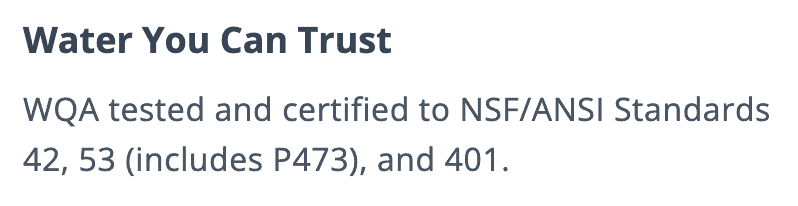
Why does it say “certified to NSF/ANSI Standards” instead of “certified by NSF/ANSI”? Are they trying to trick you? Are they trying to make it seem like their filters are certified by NSF when they’re really not?
Nope… This is just the way the system works.
Remember: NSF is the organization that sets the standards, it is not the only ANSI-approved organization that can test and certify according to those standards. There are the others we talked about: like WQA, IAPMO, etc.
Since Aquasana’s water filter is tested and certified by WQA, it has met the same standards as if it had been certified by NSF.
Now, what if the filter says “tested to NSF standards” but it does not say certified? That might be a yellow flag.
A company might say something like “tested to NSF standards” if they had a lab test some aspect of the product, but they didn’t go through the official certification process.
There are a number of reasons why a company might get their filter tested but not go all the way through the certification process, and we’ll talk about those in a minute.
This claim doesn’t necessarily mean the water filter is bad, but it does mean you probably want to dig deeper. You may want to look into the test results yourself to see if they stack up, or you might want to find some additional independent testing that can verify the filter’s capabilities.
Not All Certifications Are Equal. Check the Standard Number!
Here is yet another way these certifications get confusing. (I know—I don’t think they could have come up with a more confusing system if they tried!)
There’s not just one certification. There are actually many different types.
Let’s say you find a filter that says “NSF/ANSI Certified.” Okay, but certified for what, exactly? This is an important question because NSF/ANSI has many different standards, each covering different aspects of water treatment.
A filter could be certified to one standard but not another. As a consumer, you need to look for the specific standard numbers to understand what the certification actually means and whether or not it’s a filter that can remove or reduce what you want it to.
For example, a common one is NSF/ANSI 42. If a filter is certified to Standard 42, that tells us it was tested for improving aesthetic aspects of water—things like chlorine taste and odor, or removing particulates that make water look or smell bad.
NSF/ANSI 42, however, does not cover toxic contaminants like lead or PFAS. So a filter that is “NSF 42 certified” is good for making water taste better, but it doesn’t guarantee the water is safer in terms of heavy metals or other health hazards.
In contrast, NSF/ANSI 53 is the standard for health-related contaminant reduction. This one tests for things like lead, mercury, cysts, VOCs, etc.
To make matters even more complicated, Standard 53 covers a range of contaminants and a given filter might only be tested for a few of them. A filter could be NSF 53 certified for lead removal but not for, say, chromium or PFAS, unless it specifically went through tests for those too. So even with NSF/ANSI 53 certification, you want to know which contaminants were included.
The lesson is: just seeing “NSF certified” isn’t enough. You need the standard number (and ideally the list of contaminants too). Reputable manufacturers will spell out which standards and which contaminants their product is certified for.
You might see something like: “Certified by WQA to NSF/ANSI 42 for chlorine taste and odor, and to NSF/ANSI 53 for lead, mercury, and cyst reduction.” That is specific and useful. On the other hand, beware of vague labels. For instance, if a box simply has an NSF logo without context, check the fine print. Sometimes packaging will use the NSF logo to indicate something like material safety only (e.g., “NSF compliant materials”) which is not the same as contaminant removal.
BOROUX is an example of this. They market their filters as being “Certified for Your Family’s Health”, but it’s only certified to the NSF/ANSI 372 standard. This standard is just one of the many NSF/ANSI certifications a water filters company can obtain. The 372 standard only verifies that the filter device itself is free from lead. It does not certify that the filter can reduce lead (or any other contaminants) from the water.
This is how a company can make it seem like their filter is certified for effectiveness, when that’s really not the case.
To help make sense of the alphabet soup, here’s a quick-reference chart of common NSF/ANSI standards you’ll see on home water filters, and what they mean:
| NSF/ANSI Standard | What It Covers | Type of Certification |
|---|---|---|
| Standard 42 – Aesthetic Effects | Taste, odor, and appearance improvements. Certifies filters for reducing non-health-related things like chlorine, chloramines, and particulate matter that can cause cloudiness or color. These filters may still make your water a little healthier, but it’s not certified to do so. | Performance (Aesthetic only) |
| Standard 53 – Health Effects | Health-related contaminant reduction. Covers filters that remove or reduce substances with health concerns. This includes heavy metals (like lead or arsenic), cysts (like Giardia, Cryptosporidium), pesticides, VOCs (like industrial solvents), and more. A filter can be 53 certified for one contaminant but not for another. | Performance (Health contaminants) |
| Standard 401 – Emerging Contaminants | “Emerging compounds” reduction. Addresses unregulated or newly recognized contaminants. Examples include certain pharmaceuticals (like estrogenic compounds), herbicides, and other chemicals of emerging concern. Many of these contaminants have not yet been “officially” recognized by the EPA as being substances of concern. Microplastics, for example, are currently included under the 401 standards. Microplastics are not currently recognized or regulated by the EPA at all, but it’s obviously something consumers want to filter out of their water. | Performance (Emerging compounds) |
| Standard 58 – Reverse Osmosis Systems | Reverse Osmosis (RO) units. This standard is specific to point-of-use RO filtration systems. RO systems can remove a broad range of contaminants. NSF 58 tests that the system achieves a high percentage of TDS (total dissolved solids) reduction and specific contaminant reductions (like arsenic, nitrate, fluoride, radium, lead, and VOCs). Essentially, it certifies an RO unit’s overall performance. | Performance (RO system multi-contaminant) |
| Standard 372 – Lead-Free Materials | Certifies the actual product is made without lead. This standard is NOT about filtering out lead from water. NSF/ANSI 372 is a safety standard that ensures any wetted surfaces of the device (the parts in contact with water) contain a lead content of no more than 0.25% by weight. This basically certifies that the filter housing, fittings, etc., are “lead-free” under modern plumbing definitions. If you see “NSF 372 certified,” it means the product itself won’t leach lead into the water. But again, it says nothing about removing lead or any other contaminant from water. | Material Safety (no performance claims) |
| NSF Protocol P473 – PFOS/PFOA (PFAS) | Removal of PFAS “forever chemicals” (PFOA & PFOS). P473 was a special NSF protocol (not a full ANSI standard) developed when concern grew about PFAS in water. It specifically tested whether a filter could reduce two notorious PFAS chemicals (PFOA and PFOS). Filters that passed could claim “NSF P473 certified for PFAS.” In 2019–2020, NSF integrated these PFAS tests into Standards 53 and 58 (adding PFAS criteria to those official standards). So you might still see P473 on older product literature, but newer filters might simply list NSF/ANSI 53 (with PFAS) instead. P473 has been folded into the 53 standard and is being phased out. | Performance (Specific chemicals – PFAS) |
This is not an extensive list of all NSF standards. There are other NSF/ANSI standards you may encounter, often for specialty systems. For example:
- Standard 44 covers water softeners (ion exchange units for hardness removal)
- Standard 55 covers UV disinfection systems (for microbiological treatment)
- Standard 244 covers filters intended to protect against intermittent microbiological contamination in otherwise treated water (like a post-filter for bacteria)
- NSF Protocol P231 is used for microbiological purifiers targeting bacteria/viruses in sketchy water (often for outdoor or emergency filters)
These are less common in everyday home use, but it’s good to know they exist if you have specific needs. For most consumers dealing with city water or common contaminants, Standards 42, 53, 401, 58, and 372 (as charted above) are the big ones to understand.
Standards Evolve with New Contaminants
One encouraging aspect of NSF/ANSI standards is that they get updated as new science and concerns emerge. For instance, when PFAS (“forever chemicals”) became a major worry, NSF didn’t yet have a standard including them. So they created P473 around 2016-2017 as a stopgap test.
By 2019, they had gathered enough consensus and data to incorporate PFAS requirements into the official standards (53 and 58).
In fact, the 2022 update of NSF/ANSI 53 and 58 added tests for five additional PFAS compounds beyond just PFOA and PFOS, tightening the certification as regulations became stricter. This shows that as new contaminants become concerns, the NSF/ANSI system can adapt.
Here’s How the Certification Process Works
Getting a water filter NSF/ANSI certified is a detailed, multi-step process designed to ensure that the product is thoroughly vetted. Here’s an overview of how it typically works:
- Application & Choosing Standards: The manufacturer decides which NSF/ANSI standard(s) apply to their product based on the claims they want to make. For example, if a filter pitcher claims to remove chlorine for better taste and also reduce lead for safety, the relevant standards would be NSF/ANSI 42 (aesthetic chlorine reduction) and NSF/ANSI 53 (for lead reduction). They then apply to a certification body (NSF, WQA, or something else) for testing to those standards.
- Certain certification standards will not be applicable. For example, if the company does not make reverse osmosis filters, then standard 58 will be irrelevant for them.
- Sample Submission: To prevent a company from sending a “special” high-performance unit, the certifier will obtain random samples of the product. Often, the certifier either picks units off the production line or may even buy the product anonymously from a retail location. This ensures the units tested are exactly what consumers would get, not an optimized prototype.
- Laboratory Testing for Performance: The core part of the certification process is running the filter through a series of standardized lab tests for each claim the company wants to make. The NSF/ANSI standards lay out “challenge tests” that simulate real-world filtering but with carefully measured contaminant levels. The lab will repeat tests for the filter’s entire claimed lifespan. For example, it will continue running the filter up to its rated capacity (say, 100 gallons) to make sure it can still filter for as long as it says it can. This proves the filter can still perform at end-of-life, not just when it’s new.
- Lab Testing for Safety & Integrity: The NSF/ANSI standards don’t only check filtering performance. They also want to know if the filter itself is safe and durable. For example, the lab may test material safety by soaking the filter components in water to see if they leach any harmful chemicals into the water. These tests may differ depending on the type of filter. (For example, a whole-house filter may need to be tested to make sure it won’t connect in a way that would contaminate your plumping, whereas that wouldn’t be an issue for a pitcher filter.)
- Evaluating the Results: If the filter successfully meets the performance reductions then it “meets the standard.” The certification body will then allow the manufacturer to use the certification mark and will list the product on their website or directory as certified for those specific standards and contaminants.
- Ongoing Compliance: Certification isn’t a one-and-done deal. It must be maintained annually. Typically, the certifier will inspect the manufacturing facility at least once a year to ensure quality hasn’t slipped. They may pull new random samples periodically and run key tests again. Certification is only valid for one year at a time, so the company has to renew it each year. If the manufacturer changes anything significant about the product (like a new material, or a different carbon source in a carbon filter), they are required to inform the certifier and might need to undergo partial re-testing to ensure it still complies. This guards against “shortcuts” being taken after certification. If a product ever fails a re-test or the company doesn’t comply with audits, the certification can be withdrawn.
Why Some Companies Skip Certification
Given the rigor of the process, you might wonder why any manufacturer would not get their filter certified. In truth, many filters on the market are not certified. There are several reasons a company might choose not to pursue it:
- Cost: The certification process costs money, and potentially a lot of it. Each contaminant test, each standard, and the annual renewals all add up quickly. For a small company or a low-cost product, this can be significant.
- According to some water filter companies, getting a single product certified can cost anywhere from $30,000 to $80,000 in application fees alone, then $6,000 annually to maintain certification after that. Then on top of that, there are multiple different types and even subtypes of certifications. There are the different standards themselves, but then there are many different contaminants that can be tested for under Standard 53 (for about 90 possible certifications total).
- Fear of Failure: Some companies might worry their filter won’t pass the stringent tests. Rather than risk an official failure (and the need to redesign the product), they opt not to test at all. (Remember: testing and certification is voluntary.) As the Tap Score team puts it, a company may skip certification because their product “doesn’t work as well as they claim.” It’s essentially an honor system if they don’t test… And unfortunately a few bad actors might take advantage of consumers’ lack of knowledge.
- Time to Market: Getting certified takes time (possibly months or even years for all tests and paperwork). A startup might decide to market it immediately and pursue certification later. They might collect some third-party lab data (without full certification) to support their claims in the interim.
- Niche or Alternate Claims: In some cases, the contaminant a filter targets might not have an NSF/ANSI standard yet. For instance, for years there was no official NSF standard for PFAS chemicals like PFOA/PFOS. A maker of a PFAS-specific filter in the early days couldn’t get an “NSF/ANSI” certification for PFAS removal because the standard hadn’t caught up. Similarly, some microbial filters for campers claim to eliminate viruses per EPA guidelines rather than NSF standards (since NSF’s microbial standards are specialized). A company in such a niche might skip NSF certification if it doesn’t perfectly align with their claim, or if they pursue a different testing protocol.
- They’re in the Middle of the Process: Similar to the “time to market” reason above, a lot of companies (especially newer ones) have certified some of their products but not all. As Clearly Filtered says, “it takes time for each contaminant claim to be certified.” Most companies sell multiple different products, and there are hundreds of contaminants to test for each of those products. Some companies may be going through the certification process gradually in order to budget for time and costs.
As you can see, some of these reasons are valid and understandable. It’s important to note that not having NSF/ANSI certification doesn’t automatically mean a filter is poor.
Some uncertified products might perform very well, and may even exceed NSF standards. The problem is that buyers have less reassurance. Without that “seal of approval,” you’ll need to scrutinize the product’s test data (if available) or find trusted reviews and independent testing, because there’s no watchdog verifying the claims.
Limitations of NSF/ANSI Certifications
While NSF/ANSI certifications are often considered the ‘gold standard’ for water filter testing, they are not perfect. (No third-party certification is, if I’m being honest.)
Here are some potential shortcomings to keep in mind:
- Lab conditions vs. real world: The NSF tests are done under controlled conditions, which may differ from your actual reality. In practice, filter performance can vary with water chemistry, location, usage, etc. For instance, if your water has a lot of sediment, it might clog the filter faster than the test scenario, potentially reducing its effectiveness sooner. Or if you run water at a higher flow rate than tested, contaminant removal might be less. The standards often try to simulate a “worst-case” scenario (they may use water with high contaminant levels for example), but they can’t cover every scenario. So, view certification as proof of capability under test conditions, not an absolute guarantee in all conditions.
- Maintenance is on you: Certification assumes you follow the manufacturer’s instructions, especially regarding filter replacement frequency. If a filter is certified for 100 gallons, it means it can handle 100 gallons and still meet the reduction requirements. If you push it to 200 gallons, it may start leaching captured contaminants or just not work. Similarly, the certification is tied to using the filters that are meant to go with the device. Using an off-brand or aftermarket cartridge in a certified filter system means that cartridge itself likely isn’t certified and may not perform the same.
- The system is so confusing: As I’ve mentioned, and as you’ve seen if you’ve read this far, this whole system is complex. Some marketing can exploit the complexity of standards and it can lead to misleading or partial claims. I’ve given you the example of BOROUX proudly saying they are “NSF Certified”, when in reality they’re not certified to reduce or remove anything.
- They don’t offer certifications for all contaminants: As Clearly Filtered states, “NSF only offers 90 certifications for the 365+ contaminants we tested.” For many contaminants, you may want to look for more testing on the company’s website because NSF/ANSI doesn’t address them.
- Obtaining certification does not equal 100% removal: NSF standards usually set a performance threshold. A filter might reduce, say, 90% of a contaminant and pass if the remaining level is below the set limit. That’s great and usually what we want to look for. But if you’re expecting “zero” of something, know that certification doesn’t always imply absolute removal. For example, a lead-certified filter might reduce lead from 150 ppb to 5 ppb (which passes the standard since 5 ppb is below EPA’s 15 ppb action level). So don’t be shocked if you see a tiny residual in lab test reports. This might be disappointing to some consumers, but it’s just the reality of the world we live in—we cannot completely get rid of all toxicant exposures around us. But if we reduce exposures by 90 percent (or even 70 or 60 or 50 percent!), that’s still a good thing in my opinion.
- NSF/ANSI Certified filters can cost more: Since obtaining and maintaining multiple certifications is costly, certified water filters might come with a higher price tag. Companies may have to weigh certification with providing a more affordable product.
I believe that third-party certifications (whether we’re talking about NSF/ANSI or something like OEKO-TEX for textiles) are helpful, but they are not an end-all-be-all. They do not indicate perfection, and consumers should still use discretion when shopping.
Are There Other Certification Systems?
In the U.S., NSF/ANSI standards are basically the only game in town when it comes to widely recognized performance certification for home water filters. There aren’t really alternative certifications a water filter company could pursue.
The EPA does have some regulations on microbiological water purifiers (ones that remove things like bacteria and viruses), but that’s it.
I do think that independent testing can come in handy here. When water filter companies simply cannot afford to certify their filters for many contaminants, independent testing by people and organizations like Water Filter Guru and the Environmental Working Group can help consumers see real-world test results from various water filters (without having to shell out their own money for testing!)
Lastly, this is one thing AI is good for. I have used AI to analyze the various test results published on water filter company’s websites to see how they stack up.
For example, I asked AI to analyze both BOROUX’s and Epic’s test results (which I got off of their respective websites) and to tell me whether or not their results are up to NSF/ANSI standards.
The robot gave me some reasons why BOROUX’s testing may not have met NSF/ANSI standards (more on those reasons here), while it could not find any disqualifying factors in Epic’s tests (even after I asked it several follow up questions). This is helpful in verifying Epic’s claim that their performance “exceeds NSF/ANSI standards”, despite the fact that they are not certified for all of those contaminants.
(Of course, we all know that AI can be wrong! But when this information is used in conjunction with other info, such as the independent testing I talked about before, I think it can be helpful.)
State-Level Regulations: California, Iowa, and Others
We’ve established that federally there’s no requirement for filter certification. However, a few states have stepped in with their own rules to try and protect consumers from false claims. The two most notable are California and Iowa.
- California: If a product claims to reduce certain health-related contaminants, it must be certified by an ANSI-accredited third party and registered with the state before it can be sold. The State Water Resources Control Board manages this process and keeps a public list of approved devices. If a company doesn’t get certified, it either has to avoid making health claims or not sell in California.
- However! →
- There are only certain ‘health-related’ contaminants covered under this law. At the time of this writing, only nitrates; arsenic; chromium; lead; bacteria, virus and cysts; and organic chemicals (such as by-products of chlorination) require registration. PFAS, for example, are not included.
- Additionally, there seems to be no enforcement of the California law as of yet. (Perhaps they are just giving companies time to get certified and registered before they start enforcing it? I’m not sure.)
- Lastly, there is a lot of cloudiness on what is actually required from brands when they make “health-based claims.” One filter brand told me that California’s SWRCB requires registration only for filters that are officially certified to reduce arsenic, lead, chromium, or nitrates. They said that when they submitted their testing data to the SWRCB, the SWRCB informed them that registration wasn’t required because they’re not certified for any of those four compounds. This is different than what the SWRCB’s own website says. The SWRCB website says that all claims need to be registered accordingly, but the company I referenced was told that only official certifications need to be registered accordingly.
- In short, it seems like we’re getting contradictory information from California’s SWRCB and they may still need to iron out some of the details of this law.
- Iowa: Like California, Iowa requires filters that make health claims to be lab-tested and registered with the state. Manufacturers must submit test data proving the product meets NSF/ANSI standards (or equivalent). It seems like Iowa is in a similar boat where this law is not currently being enforced in a standardized way.
These state-based water filter regulations seem like a bit of a hot mess right now, to be honest. They are probably on the right track, but without clarity, consistency, and enforcement, these laws don’t mean much at the moment.
I hope to be able to update this in the future!
In Summary
Alright, so summarize everything we’ve talked about:
- There are no federal regulations on water filters, which leaves consumers vulnerable to false advertising. Companies can say their filters reduce or remove certain contaminants, but there is no accountability for those claims from the federal government.
- NSF, ANSI, and a few other organizations fill in this gap by providing drinking water standards and certifications.
- NSF and ANSI are two separate organizations that work together. NSF sets the water filter standards and ANSI approves them.
- ANSI also approves the organizations that can certify water filters according to the NSF standards. NSF is one of those approved organizations, but there are a few others: WQA, IAPMO, UL, and CSA Group. So for example, the Water Quality Association (WQA) is approved by ANSI to test and certify water filters according to the standards set by ANSI.
- Testing and certification is voluntary. The reason companies do it is to assure customers they are selling an effective and high-quality product, not because it’s legally required.
- There are some new laws in states like California and Iowa that are starting to regulate water filters and the claims they are allowed to make. However, these laws are not yet being enforced in a standardized way.
- “Certified to NSF/ANSI Standards”, “NSF Certified”, and “Tested to NSF/ANSI standards” mean different things. A company can:
- Get their products tested and certified by NSF itself (which is one of the 5 ANSI-approved organizations that can certify).
- They can get their products tested and certified by a different ANSI-approved organization such as WQA or IAPMO. (These certifications are just as legit as NSF.)
- Or they can get their products third-party tested to NSF/ANSI standards without becoming certified.
- There are many types of certification standards, which look at different things. For example, NSF/ANSI standard 42 looks at aesthetic effects. 53 looks at health effects. Ideally, you’ll want to look for certifications (or testing) for multiple standards.
- Many water filter companies choose to skip certification, in large part because of how costly it is to obtain and maintain. Just because a water filter is not certified does not automatically mean it’s bad, but you do lose some reassurance. You’ll still want to thoroughly look at their tests (and maybe find some other independent testing as well).
- Just like all third-party certifications, NSF/ANSI is not perfect. Tests are done in a lab, not the real world. They don’t offer certifications on all contaminants. Certification does not indicate 100% removal of contaminants. It’s certainly very helpful in providing accountability and assurance, but it’s not an end-all-be-all.
- There are not any alternative rigorous certification programs for water filters; NSF/ANSI is pretty much the only one. That said, looking at other independent testers’ results (like Water Filter Guru, EWG, or Tap Score) can be helpful.
My Take On All of This
I’ll be honest with you: I find this whole system annoying and even frustrating.
It’s way too complicated for an average consumer to understand. If I had it my way, we’d have a system that was:
- Less confusing in terms of the organizations involved. (For example, some customers think that being certified by the Water Quality Association is less legitimate than being certified by NSF, but it’s not. They’re both using the same exact standards and testing and they’re both approved by ANSI.)
- More affordable for brands. (I have been told by multiple smaller water filter brands that getting and maintaining certifications is “ridiculously expensive”—especially since there are so many different contaminants you could certify for.)
- Consistent across all states. (The California/Iowa rules just make things more confusing. They cover some ‘health-related’ contaminants, but not all of them. And again, this rule is apparently not even being enforced.)
- Somehow more clear about which contaminants are involved. (Again, all of these different standard numbers I think just make things confusing for the average consumer.)
This is a tough topic because on one hand, I really do think we need accountability and third-party testing when it comes to water filters.
However, I also empathize with water filter companies who simply cannot get and maintain certification for every single contaminant. There are about 90 different NSF certifications, and water filter companies usually have multiple products. Obtaining and annually renewing certifications for every contaminant for every product they offer… I just don’t think it’s feasible if they’re going to be able to offer customers an affordable product and compete in the marketplace.
I think that’s why a lot of companies have gotten 1-3 certifications and published their full test results on their website so that customers can see that their test results are still in line with NSF/ANSI standards, even if they are not officially certified.
I definitely appreciate folks who do their own testing (like Water Filter Guru and EWG, like I mentioned before) so that we can verify a filter’s capabilities, whether they are certified or not.
What do you think about all of this? Do you have any other questions that weren’t addressed here? Let me know in the comments below!